“There is nothing like football is there? Nothing can make you feel every emotion like a football match.” Kevin Maybe.
Portsmouth is the most densely populated city in the United Kingdom. The latest data calculated the population to be 208,100. As a seated stadium, the largest crowd here was in 2009 versus Spurs when 20,821 pitched up. That equates to about 10% of the total island city population, although many Pompey fans don’t live in the city. When Pompey played Derby in the FA Cup in 1951, the crowd was more than 20%, one-in-five of the city’s residents. Imagine! Every fifth person in the city going to Fratton Park. It is hard to believe that possible.
I knew a man who proudly told me he was there in 1951, although I am more impressed now if someone boasts of being in the crowd of 1,200 versus Bristol Rovers in the 2016 EFL Trophy match, which was Pompey’s smallest crowd since 1946.
Have you ever wondered about the 90% of the city’s people who don’t go to Pompey matches? What are they doing? Up at the QA on Portsdown Hill, there are some wards that overlook the city from which the lights of Fratton Park are clearly visible. Up there, patients are able to listen to Pompey’s home matches on the QA Hospital Radio via the Pompey Audio Description commentary service.
This service was initially set up in the 2015/16 season in partnership with the Portsmouth Disabled Supporters Association to bring match commentary to partially sighted Pompey fans at Fratton Park, but has now been wired into the QA Hospital Radio service. Why not just listen to the BBC Radio Solent service, you might ask? Well many patients may do, but the Audio Description service commentators are specifically trained to describe the action non-stop, with the asides and chat saved for pre-match and half-time, so that listeners know exactly what is happening, as it happens. It is detailed commentary, focusing precisely on where the ball is and what the players are doing.
A couple of the original Pompey AD commentators are now working for national radio and other TV stations, as the current dedicated team certainly could be, given the great service they provide to their listeners.
Besides Pompey fans too unwell to attend, there are a large number of people in Portsmouth who are freed up to enjoy a bit of personal space, while one, or more of their household is down at ‘The Park.’ My grandmother would settle into an armchair with a cuppa and watch the wrestling on ITV during Saturday afternoons, while my grandfather was at football. Some people go down to Gunwharf Quays, (or Gunwharf Queues as I call it), for some shopping, meaning many people have to be there working too, to take their money.
Some people of nervous disposition cannot go to games due to the anxiety a Pompey game can bring on. My grandfather’s doctor told him to stop going to games because his heart was no longer up to the strain, which sadly turned out to be true, although he was spared watching Pompey ever playing in Division 4, which was a blessing of sorts.
In Nick Hornby’s first book Fever Pitch, he writes of his dream of buying a house next to Highbury, which came true due to the sales success of his book. As a result he could just pop out the door to watch his beloved Arsenal, but then they moved to a new stadium down the road, but not too far. I wonder how many of Pompey’s neighbours have achieved the local equivalent, fulfilling a lifetime’s ambition by living next door to Fratton Park?
For other neighbours, matchdays might be the worst day of the fortnight. What with the crowds roaring, parking restrictions, police horse dung in the street, match days might be days to go off the island and walk on the Downs, or the beach at The Witterings, although from both you can still see the glow of the lights (as you can from the Bognor Regis prom). In the 1940s and 50s, some of the neighbours used to charge 6d to look after the bicycles of fans, so making a bit of pocket money from the gathering throng.
A poem by Rebecca Loveday, captures the excitement and anxiety of watching Pompey hang onto a one-nil lead against Leeds United, as the final minutes are played out. Early leavers may just be following doctor’s orders, but for many, this is when the drama and sheer joy of attending is most keenly felt, which is exactly why they are here in the first place.
~
n.b. This article, with Rebecca Loveday’s poem, was first published in the Portsmouth FC v Wrexham FC match programme on 5th November, 2026.
Being ‘On the Bench’ once simply meant being a magistrate. As Micky Quinn infamously was reminded when being sent down for 21 days after being caught driving while disqualified twice in a month, magistrates have to dispense justice regardless of Pompey’s need for goals. Alan Ball, Pompey’s then manager, was in court with Quinn and instructed his prize chump Centre-Forward to plead guilty and do his time. Ball needed to know which games Quinn would miss, so he could be certain of his available squad and work out tactics accordingly until the Liverpudlian was released.
In football terms, being on the bench became a thing in England during 1965/66 when, the FA finally caught up with associations around the world, who had allowed subs since the 1950s. It took another season for the men in blazers to allow tactical substitutions. Being a substitute was not quite as good as being in the team, but at least the player selected for the role had a chance of being involved. Sitting alongside the manager in the dug-out (a phrase taken from the military world) might be an opportunity to learn more of the manager’s thoughts, maybe get in his ear about how you might improve things, or just 90 minutes hoping someone might get injured enough to leave the field, or to be so totally out of sorts that you might get to kick the ball in anger.
Before the 1965/66 season, a serious injury to a player could turn a game. In the 1929 FA Cup Final, Pompey missed several chances to lead before Tommy Bell was reduced to a limping passenger out on the wing. His knee injury let Bolton Wanderers into the game, which they won 2-0. Again, injuries contributed to the outcome of the 1934 FA Cup Final, when an injury to Pompey’s Jimmy Allen, who left the field, led to Manchester City equalising and then grabbing a late winner. The Football Association stuck to its ways, regardless of the impact injuries could have on its showpiece event
Colin Garwood, Pompey’s mercurial goal scorer, sold to Aldershot after financial disagreement with Chairman John Deacon, was one of the first specialist substitutes. A slight, but prolific striker, rather than a jack-of-all-trades to cover all possible options, Garwood could be used to sharpen up the team. He was a goal-scorer, pure and simple. He hated sitting watching the game and could not wait to get on the field to prove he should have been picked to start.
One sunny afternoon, at home to Port Vale, released from the confines of the touchline by manager Jimmy Dickinson, Garwood scored a spectacular goal. Collecting a loose ball in the centre circle, he lobbed the Vale keeper, Trevor Dance, from forty yards to secure a 2-0 win. He remembers that goal well, because he was so frustrated at only being picked as sub that afternoon.
Somehow, from a lone substitute, who would sprint along the touchline from time to time to save his legs from seizing up, we now have a wall of track-suited players jumping about, stretching, having a chat, lining the touchline for much of a game. The move from three substitutes to a maximum of five chosen from nine on the bench in The Championship must be challenging for the players.
The number of substitutes now allowed gives unprecedented power to the team coach and rewards the clubs with the deepest pockets, who can afford to have top players sitting most of each game out. Being able to offer just the hope of playing on Saturday, rather than the high likelihood of getting a full game, has changed the dynamic between coach and players. Now there is talk of ‘starters’ and ‘finishers’, to ensure all the players feel involved from kick-off. A finisher used to be player like Guy Whittingham who scored lots of goals, not a player who gets to play for just half an hour, or less.
Nine on the bench also places greater pressure on the coach to ‘do something, do anything’ if things aren’t quite going to plan. Spectators and owners demand more of the coach to intervene. Players are increasingly seen as being disposable during a game and the substitutes are required to increase the intensity of the team’s performance. I wonder whether this injection of higher pace and energy contributes to an increase in injuries, when players naturally tiring from being on the field from the start, come up against fresh, fired-up substitutes, not just one of them, but half the team. Have we gone from substitutes only for injuries, to injuries because of too many substitutes? One for the football statisticians to study.
~
The Number Twelve
I wandered lonely as a substitute Waved to family in the crowd Swapped brief banter with the fans Joined in with clapping to warm my hands
When I see the trainer's run on I jump up and sprint down the line Hoping the pain is not too bad Just enough to let me play
Monday to Friday is the hard work Training is fun and the lads a good bunch Lots of running and set play drills in the morning Then off to play golf or to the pub for lunch
Being sub is better than not being involved I’ll do what I can to impress the Gaffer It’s the way it is, how the game’s evolved But I want to play football, not just tread water
~
n.b. This article was first published in the Portsmouth v Ipswich Townmatch programme on 14th April, 2026.
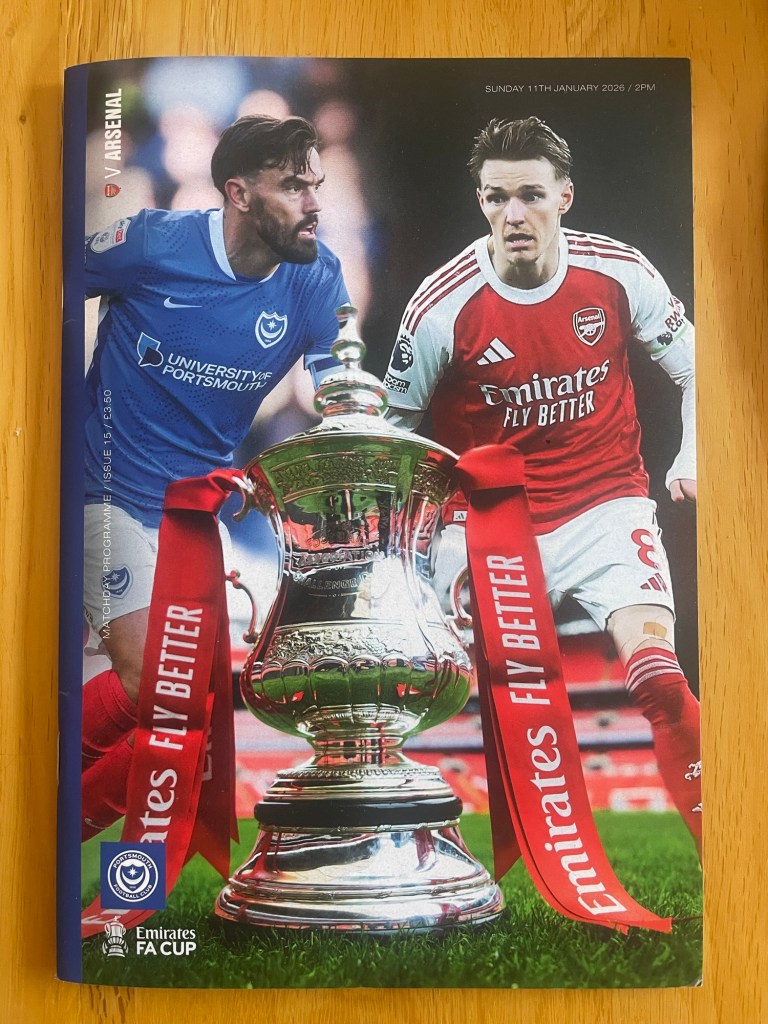
Thank goodness we can put aside the stress and worry of battling for Championship points today and dare to dream of beating the mighty Arsenal. Today, I want Pompey to roll up their sleeves and give everything to knocking the Gunners out of the competition. I want every Pompey player to play with pride in the shirt and to relish the opportunity to stamp fresh glorious memories in the history books of our club.
How this day would stand out in our lives if we are victorious. Imagine for a moment, being part of a heroic team that downed Arsenal in front of a packed, passionate Fratton Park. Imagine how it would feel for us to be part of such a famous win, with our throats sore from singing Pompey to victory. Think about the buzz we would have travelling home after such a win. Ecstasy would barely describe the sensation. I can envisage my cousin, Claire simply throwing her head back and laughing about today for many, many years to come, were we to triumph this afternoon. Being a Pompey fan would be an even bigger badge of honour to carry than normal.
All I dream of when it is the FA Cup Third Round is of Pompey getting through to the fourth round. We all know that Pompey winning the FA Cup for a third time is unlikely to happen this season, but it is not unreasonable to believe we can make it to the next round draw. Was Pompey’s Wembley win in 2008 the best moment ever as a Pompey fan, or was it beating Spurs 2-0, two seasons later in the FA Cup semi-final? Picking up the trophy in 2008 was good, but that win over Spurs fuelled by the roars of The Blue Army, was one of the greatest Pompey days of my life.
Other memorable Pompey FA Cup matches that spring to my mind are: beating Manchester United 1-0 in the 2008 Quarter-Final (which I only saw the second half of on a pub telly in Brighton); winning 3-2 at Division One Leeds United in 1977, when Pompey were in Division Two; the last-minute win, 1-0 at Championship side, Norwich in 2019, when Pompey were in League One. Winning the FA Cup in 2008, comes a bit lower in the list, mainly because we were expected to win.
Of course, there is the B-side of Cup memories, the crushing disappointment of unexpected defeat. Mention Leyton Orient to Pompey fans and they will groan out the name Kawaguchi, who had a nightmare in Pompey’s goal in January 2002. Thinking about 2005, all I can recall is the dodgy penalty call against Matty Taylor, leading to a last-minute winner scored by Peter Crouch, as in 1990 when Ian Wright’s last-minute penalty for Crystal Palace away, totally ruined my birthday.
The FA Cup is not about the final game at Wembley. The FA Cup is about giving every club in the country the chance to mix it for ninety minutes with any other club, however big or small. It is about giving us all a brief burst of hope for just one afternoon in the middle of winter’s gloom. With the FA’s abandonment of replays in all full rounds of the FA Cup, it could be argued that smaller clubs have a better chance of finding a way through, even if it is on penalties, so let us all get behind Pompey with hope in our hearts and give it our all. Play up Pompey!
~
Pundits versus Fans
FANS:
Oh, we’re on the way with Moushino’s Army
We’re on the way to Wem-ber-ley
We’ll really shake ‘em up
When we win the FA Cup
Because Pompey is The Greatest Football Team
PUNDITS:
Oh, it’s a big day for proud Pompey
It’s a day to forget the league
They haven’t got a hope
Unless they use rope a dope
Because Arsenal is by far the better team
FANS:
Wem-ber-ley, Wem-ber-ley
We’re the famous Portsmouth FC
And we’re on our way to Wem-ber-ley
PUNDITS:
Wem-ber-ley, Wem-ber-ley
Pompey should re-focus on the League
Pompey ought forget about Wem-ber-ley
FANS: When Sol went up To lift the FA Cup We were there We were there
~
n.b. This article was initially published in the Portsmouth FC v Arsenal match day programme on 11th January, 2026
Here we are again, playing Leeds United, an original phoenix clubs, who rose from the ashes of the infamously financially dodgy Leeds City FC.
Known as The Peacocks for decades after formation in 1919, Leeds United either took their nickname from The Peacock Inn across the street to Elland Road, or because of the garish combinations of old gold and blue shirts worn by the team from formation until 1962. Now the white of Real Madrid is the club colour after Don Revie imposed it, with little whisper of fan protest, while yellow and blue (the city’s official colours) have become a staple part of United’s away kits.
Pompey fans know how important club colours are to our identity. Witness the row about the short-lived red Emirates sponsorship of the Millennium Tower. We are vehement defenders of the royal blue shirts, white shorts kit, with our red socks (suggested by long-time Club President, Field Marshall Montgomery) a vital, un-substitutable element. Home kits are pretty much standard these days, but Away kits and Third kits are the marketing team’s dream.
Nostalgic and historic colour schemes often prove popular, not least last season’s salmon pink of Pompey’s 125th Anniversary tribute to our first ever team kit. Club kit designers consider whether any prospective design will be worn by supporters as leisure wear, which explains why black is often used, ignoring the fact that, from a football perspective, that a team-mate in a dark shirt will be less easy to spot than one in bright blue, white or red.
Incidentally, red has been identified by some social scientists to be the shirt colour of teams that win the most sports trophies, but this theory is clearly nonsense given the history of football in Hampshire.
The worst away kit I have ever seen was Cardiff City’s 1972/73 away kit of lilac and primrose, first worn at Fratton Park in August 1972. On a blistering afternoon, Cardiff’s players were squinting into the Sun as it began setting between the South Stand and Fratton End. They had taken a first-half lead from a Derek Showers goal, but as the game and heat wore on, after a Pompey equaliser from Brian Lewis, Pompey were handed the lead in bizarre circumstances. It was the 80th minute when Cardiff won a throw-in on the South Stand touchline, in their own half. One of their players ran over insisting he take it, so caught the ball that had been thrown toward him by his team-mate. Referee Harold Davey (a FIFA list referee of the time) immediately ruled that the catch was handball because the throw had been made in accordance with the laws of the game. You can imagine the complaints from the men in lilac and primrose shirts at that decision. From the free-kick Norman Piper put Pompey ahead, to the home crowd’s cheers and laughter. A third Pompey goal via Richie Reynolds in the 89th minute made it a 3-1 win.
Derek Showers remembers the awful kit and the game well. Born in 1953, Derek had grown up knowing that Pompey were one of the great teams of English football in the post-war years. He was absolutely thrilled to have scored at Fratton Park. He remembers floating home on a high. “After getting off the team coach at Ninian Park, I caught the train up The Rhondda to Merthyr, but because the last bus had gone, I had to walk the last mile or so to my village. I had just scored against mighty Pompey at Fratton Park and there I was, past midnight, walking up the valley with my football boots hung over my shoulder. ‘So much for the glamour of being a professional footballer’ I thought.”
After joining Pompey from Bournemouth & Boscombe, when Pompey were struggling in Division 4, Showers learned how tough life as a footballer could be.
He suffered an injury that nearly cost him a leg. As he was not a prolific goal-scorer, he suffered some vitriolic criticism from the terraces. Despite this, the centre-forward nicknamed Nookie Bear by Pompey fans, still has brightness in his eyes when talking about playing at Fratton Park. He had been discovered by Leeds, Juventus and Wales giant, John Charles and signed for Cardiff at 15 years of age. Today, Derek looks fit and strong enough to still play the game for a living. As for team kits, Showers would pull on a shirt for whoever was going to pay his wages and help keep a roof over the heads of his beloved family.
Leeds Sonnet 2024/25
Hot August day, hope stitched on our sleeves We travelled north to take on mighty Leeds Never thinking we might draw three – three
Graffiti, fan stickers and gable-end murals Walking side by side with the local people To Elland Road, their football cathedral
So good to be back in the second tier In the bigger towns with bigger grounds We’ll give it a fair crack, play without fear
After that heady first day, we all thought OK We were a bit lucky, but so were they No way will it be easy playing away
Now they’re here pushing for promotion While we’re back home battling relegation
n.b. This article was initially published in the Portsmouth FC v Leeds United match day programme, 9th March 2025
Football on Boxing Day is one of the nation’s favourite fixtures. To have a home match is particularly satisfying, but frankly, any Boxing Day match is to be savoured.
I was once a regular on the South Terrace, Milton Enclosure, before it was re-fashioned into the seating it is today. The South Terrace was a cold, draughty, but dry place. Close enough to the pitch to be able to smell the cut grass, the turf and players’ embrocation. The ball would frequently end up cannoning around this patch of terrace and it would sometimes be followed by a player who had slid off the pitch, across the orange tartan track and over the retaining wall onto the concrete. Players on the field could also clearly hear the expert tactical advice on offer from the enclosure and would sometimes respond directly verbally or more often using hand signals.
At the back of the enclosure, wedged underneath the Leitch commissioned steelwork, was a tea hut. It looked like a garden shed from B&Q and was staffed by a lady called Joyce Tynan. She worked alone, which meant that a massive queue for beverages would develop at half-time. This queue then merged with the queue for the toilets beside her hut. On more than one occasion, I found myself following the wrong painfully slow procession, when I actually wanted a tea not a pee.
Eventually, my friend, Dave and I agreed to take turns from match to match to nip along just before half-time to get our drinks order in early. Neither of us minded taking on the task, because it was possible to still see some of the pitch from the tea hut counter. As well as being able to keep alert to the action, it meant having a chance to have a brief chat with Joyce, who was always good natured, however poorly Pompey might be playing. Joyce had served teas at Fratton Park for many seasons and along with the senior turnstile operator, who definitely remembered Pompey’s glory years, they were two people who would always brighten any visit to PO4.
I also remember a limited option of chocolate bars at extraordinary prices being available from Joyce’s tea hut, so not many of those were bought. I used to always check the date of these slow selling products to make sure they were at least fresh that season.
Besides the steaming urn and plastic cups of coffee, Bovril, or tea options, there was a glass cabinet for keeping pies warm. After the match, with the hut locked up, unsold pies were left on the counter to take away for free to stop them going to waste.
Having beaten the half-time queue, Dave or I would be back on the terrace in double-quick time, where we could gingerly sip the boiling hot drink, sometimes having a brief chat with Touchline Tony, as he took a break from stadium announcements, to dissect with us what had gone right or wrong in the first 45 minutes.
Joyce at the tea hut was a lovely woman with an impossible job. Towards the end of her time at Fratton Park, Joyce did get an assistant, a student, who I think was simply bemused by what was expected, as waiting times did not get any shorter. Thankfully, things around Fratton Park have changed for the better.
Unlike professional rugby and non-league football, it is illegal to drink alcohol while watching a men’s professional football match, so it has been a priority for the club to ensure all catering facilities are totally out of sight of the pitch, which allows Pompey to sell alcoholic beverages throughout the match, for those who enjoy, or need, a pint at the football.
Sadly, Joyce is no longer with us, but the club is able to offer many more part-time job opportunities on match days than was previously the case, emphasising the contribution Pompey makes to the local economy. The hospitality and catering team, led by Kayleigh Young, have a challenging job in that football stadia are only opened to fans on match days, whenever they may be, whether weeks apart, or three times in eight days. Getting the food and drink stocks for each game on such an irregular basis is a bit of a gamble, which explains in part why a limited choice of food and drink is available. It is not easy getting the stock levels right for perishable products under such circumstances. Look in the Victory Bar after a win and it will be buzzing, but after a defeat, even with a full house at the game, there can be more staff than customers, as supporters head for home. As ever, success on the pitch is a big factor in how well the club does in all aspects of the operation.
After a traditional Christmas lunch, eating is the last thing on your mind, or you may have been saving yourself to tuck into a hospitality meal at Fratton Park today. Whichever it is, I hope that Pompey and QPR can provide a cracker of a match and Pompey can put the icing on the cake with a win this Boxing Day. Happy Christmas.
n.b. A version of this article was published in the Pompey v QPR match day programme on Boxing Day, 2025.
Turf Moor was once a place of mystery to many football fans, particularly those who only saw football through the TV eye of Match of The Day, on late Saturday evenings. For five years, BBC cameras were banned by then Burnley FC Chairman, Bob Lord and it was the only ground in the country not open to televised match highlights. Even rickety Layer Road, then home of Colchester United and Pompey’s Jungle Boy, Ray Crawford, was better known around the country, because of regularly repeated highlights of Colchester’s ousting of Leeds United from the FA Cup 5th Round in 1971. Bob Lord could only see bad things coming from televising football and it is thanks to him that we have a Saturday 3 o’clock embargo on live English footy on telly, protecting the traditional Saturday afternoon kick-off, for what it is worth.
After the embargo on BBC TV cameras at Turf Moor was lifted, the mystery and mystique of the place still held for me. It was the ground where Ray Pointer became famous, before he came to Pompey. Pointer, who won the League Championship with Burnley in 1960, was a hero of mine during my earliest visits to Fratton Park with my grandad. So, on 22nd April 1995, I jumped into my young family’s Peugeot 106 and drove north for a vital relegation battle between Pompey and The Clarets. Besides being the first-time I bumped into Northern Blues super-fan, Barry Thompson, the day featured a penalty lashed home by John Durnin and the best goal I have ever seen scored by a centre-back. I may have mentioned it before, but do look up Kit Symons exchanging passes with Deon Burton on the halfway line and his solo sprint that ended with our centre-back rounding the Burnley keeper, Marlon Beresford, before sliding the ball home for our second goal. The 2-1 win spared Pompey relegation in 1995. You can find five minutes of the match highlights online one hour and 39 minutes into the ‘Burnley FC End of Season Review 1994/95’.
What I recall specifically of the afternoon, was The Long Side. This was a terrace that ran the full length of the field, like our famous North Terrace. Away fans were caged towards the Cricket Ground end, separated from Burney fans by the police, steel railings and netting hanging from the rafters to stop stuff being hurled between supporters. Over the top of the Bob Lord Stand opposite, snow was lying on the hilltops and a marrow-chilling wind carrying sleet, howled down the pitch. Before the game, I was asked a few questions about our chances of beating the drop by Radio Solent’s roving reporter, (I was very hopeful we would win), before getting an excellent fish and chip lunch. I then joined Barry and Ian, another Hereford and Worcester based Pompey fan, in a local Working Men’s Club for a very sociable chat with claret and blue clad locals. In 1960 Burnley became the smallest town to ever win England’s top football division and it is still a town as proud of its football club, as we are of ours. In 1995 it seemed to me that every corner shop, petrol station, bus, taxi and local business had claret and blue as corporate colours. The number of locals wearing club replica shirts seemed far greater than I had previously seen anywhere else during my travels.
Football in 1995 was beginning to change, with the recommendations of the Taylor Report gradually being implemented. The FA, hand-in-hand with SKY TV, had turned the tables on The Football League and held all the cards at the top table of English football. Grounds were being turned into all-seater stadia, so to visit Burnley and stand on the Long Side was a chance to see how football used to be, for better or worse. As so many of we Pompey fans know, travelling to away games, meeting fans of the other team who also attend matches, remains one of life’s greatest pleasures. So, thank you to all the Burnley fans who have made it to the game this afternoon. Football and Fratton Park needs you too.
Claret and Blue Blues
I woke up one morning, snow on the ground Jumped in the Peugeot and headed Up North M1, M6 empty all the way On an expedition seeking legendary turf
At Blackburn, after what seemed an age I had to turn over the road atlas page To find the turn off to Burnley’s Turf Moor To set my tired eyes on that mythical stage
Streets painted with Claret and Blue Kerb stones, zebra crossings and traffic lights Buses and taxis, factory chimneys too Is this Burnley? Well, blow me! Who knew?
Frost on the windscreen Snow on The Pennines, sleet in the wind We are Portsmouth! Three hundred miles from home Seeking one more vital league win
Johnny Lager and Kit Symons confidently scored McLouglin and Knightsie (The Legend in goal) Dug in deep to help Pompey survive While Burnley, unluckily, slipped into decline
I woke up one morning, snow on the ground Jumped in the Peugeot and headed Up North M1, M6 empty all the way to the proud old town On my last-ditch expedition to the historic turf
Chris Perry
n.b. This article was first published in the Portsmouth FC matchday magazine v Burnley FC on 1st February, 2025
Norfolk is a big county. Over two thousand square miles and thinly populated. The median age is one of the oldest in England at 46. Unsurprisingly, unearthing football talent there is like looking for a needle on an abandoned World War II concrete airfield apron, but the county has produced a few fine players over the years. Two of them are Barry Bridges of England and Chelsea, and Ipswich’s EUFA Cup hero, Trevor Whymark.
So, it will be no shock to discover only one Norfolk-born lad, Colin Garwood, ever made it to play for Pompey. He enjoyed life in that compact, congested and densely populated island city on the South Coast. He was a tremendous success playing up-front during his brief spell at Portsmouth, scoring 34 goals in just 71 matches.
In the summer of 2023, I drove through some thunderous downpours to Downham Market to meet Colin and ask him about his playing career, particularly the period at Fratton Park. We met at a Wetherspoon’s, where with his wife, Jill patiently listened to the umpteenth conversation about the football business, during the ninety minutes, or so of our chat.
Colin was a goal scorer. As such, he was in demand up and down the country from the moment Peterborough United heard about him playing at just 15 years old for Heacham FC in the Eastern Counties League.
It was Colin’s dad, who wrote a letter to a director at Peterborough United. He sent it with some match report clippings from the Lynn News & Advertiser. This paternal initiative led to an invitation for a trial for his son.
The trial in the A team went well, Garwood scored three and his performance then and in a subsequent match, when he scored again, won him an apprentice’s contract. Although happy to be released from school to be a full-time football apprentice, there were aspects of his new working life that proved challenging.
“Give me a ball and I would happily practice day and night, but I was not keen on the physical training side of it. I found it boring.”
One of the principles of training, certainly pre-season, was the whole squad going for a long run.
“I was new to the first team and not keen on the running. So, I was jogging along at the back of the line and found myself in the company of Tony Millington, the Welsh goalkeeper. ‘You better not hang about with us old ones here. I’ve done this enough. You’ve just begun your career. You better get up front.’ Millington told me in no uncertain terms.
“I made my way up the line to lead the run, setting a bit of a pace, feeling I was doing the right thing. Grateful for the advice from Tony. I had been heading the run for quite a while, when I heard a milk float coming up the road from behind me. As it passed there was Tony Millington and three, or four others, sitting on the back of the float, laughing and waving at me!”
Besides the running regime, some of the sports psychology of the time would raise an eye-brow or two these days. From Wednesday, until the pre-match warm up, Peterborough players were not allowed to train with the football.
“The thinking was players would be really hungry for the ball by Saturday afternoon, so we’d be more determined to fight for it during the match.” The ridiculousness of the concept still bemuses him today.
By 18, Coin Garwood was ready for first team football. He travelled on the first team bus to Dean Park, where Peterborough United were to take on Bournemouth & Boscombe Athletic Football Club. Besides making his first team debut there, the young Garwood was made responsible for hauling about the two skips that held the team kit. There was a pecking order, even in the first team.
“I scored on my debut. A shot to the top left corner!” he recalls, eyes lighting up.
“On the way back to the halfway line, I asked the referee how much time was left. We had gone 3-2 up and having scored on my debut, I was wondering if I had scored the winner too.”
The match eventually ended 3-3, with Garwood substituted, but it was an encouraging start.
Towards the end of that 1967/68 season, having retained the No 7 shirt, Garwood hit a purple patch, scoring four in the last two matches of the season.
The local derby for The Posh is against The Cobblers of Northampton Town. Colin is still the only player to score a hat-trick for Peterborough United against them, as he did that afternoon. He finished the season with the opener against another relatively local opponent, Colchester United, who were demolished 1-5 at their home, Layer Road.
When he left to the London Road club to join Oldham Athletic after the end of the 1970/71 season, he was scoring at a rate of more than a goal every other game for Peterborough. This move from his local club would not be the last time that a club decided they could bring in some cash from moving Garwood on.
Colin was sold to The Latics for £10,000 where the player-manager at Boundary Park was Jimmy Frizzell, a left-back from Scotland. In his first full season, Frizzell’s team won the Third Division title, with Colin Garwood and Andy Lochhead working as a classic big man / little man double-act in attack.
Mention of Oldham prompted an aside about playing Manchester United in a pre-season match.
“I arrived at Oldham and we were told that we would be playing a friendly at The Cliff, Manchester United’s famous training ground. United still had most of their European Cup winning team from 1968. I played right wing and I was up against their number 11, George Best.
“We lost 7-0 and Best scored five. I am still not sure what we got out of that training match behind closed doors, but it was quite a thing to be up against Best and Bobby Charlton.”
Colin joined Pompey from Colchester United. He signed for what was arguably the worst team the Fratton Park fans have ever seen. Liverpool legend, Ian St. John had been unable to galvanise an ageing squad during a desperate time for the club and Jimmy Dickinson had been asked to take on the manager’s job.
“I learned that team spirit had been terrible. I was told that there had been lots of arguing, even fighting in the dressing room. Good players, like Norman Piper had been there a long time and wanted out. Some expensive players, like Paul Went, had been sold. I was bought to replace David Kemp.” Kemp was the fans’ idol.
In the season he moved to Carlisle, Kemp had scored 21 goals for a team destined for relegation. Pompey fans were beside themselves with frustration. All they had seen under John Deacon’s ownership was money spent on a team of has-beens and misfits. It was only David Kemp who offered any hope of salvation. To see him leave was soul destroying.
Jimmy Dickinson was the manager who signed Garwood for £20,000, of which 10% would be paid to the player, but it was the club Chairman John Deacon who made additional promises to help ease the deal to a close. Questions about the details of this conversation re-surfaced a few weeks later, after the new Pompey player had scored on his home debut, but was still trying to complete a house purchase just outside the city.
Deacon had offered good wages and incentives, but also there had been a clear suggestion that, additional to the traditional 10% of the transfer fee of £20,000 there would be a “tax-free” payment.
This was money that Colin had planned to use as a deposit for a house in Waterlooville, but after a couple of weeks in Hampshire, there was no sign of the agreed sum. He called a meeting with the Chairman. Frank Burrows accompanied Garwood to the meeting with Deacon, who had brought along his wife and son.
Deacon denied that there was any more money owed, but Garwood stood his ground. Mrs Deacon then leant forward on the table and asked quite pointedly, “Are you calling my husband a liar?”
With the new Garwood family home on the line, Burrows backed his player and eventually the tax-free money for the house deposit came through. Colin Garwood was then able to settle down for a bit and get on with his job of scoring goals.
I asked Colin to describe how he operated around the goal area. The few goals of his that can be found on the Internet are all quite different. A smart shot from the right and a fleet-footed move to collect a shot the keeper had spilled, that Garwood pushed away from his opponent, before spinning smartly to hook it back into the net.
To these, from my own memory I can add, a lob from about 35 yards over Port Vale’s goalkeeper, Trevor Dance on a sunny afternoon at Fratton Park and a tame shot against Walsall on a filthy, cold and wet afternoon at Fellows Park, that a kneeling Ron Green let through his hands and legs in a manner that might have been classified as an own goal, so unlikely a goal it was.
“For that goal against Port Vale, I collected the loose ball, beat about five players and then chipped the keeper from 35 yards. Frank Burrows told the press that it was worth the entrance money alone.” Garwood interjected.
All his goals seemed different, except for one factor, that of the empty space in which Garwood had found when the chance came his way.
“I can’t put it into words. Just instinct. You just know where to be. Instinct. It’s something you can’t teach.
Colin Garwood finds space to shoot again. (Picture from ‘Pompey. The History of Portsmouth Football Club.’ Published by Milestones Press Ltd. Copyright: Neasom, Cooper, Robinson 1984).
“There was another I remember, when the Rochdale keeper was rolling the ball out and I was coming back up the pitch from behind him. I nicked it off his toe and stuck in the net.”
There’s certainly a lot of mystery around why some players find the net so frequently, while others cannot. Whatever the magic formula is, Colin Garwood knew it at every club he played. Which brought us around to who this nippy and sharp-witted footballer played alongside.
Garwood is recorded in the 1971-72 Rothman’s Football Year Book, as being 5’9” and weighing 10 stone 13 lbs, relatively hefty for an athlete of that height. Despite being only average height, where ever he went he scored goals and where ever he went he was teamed up with a big man up front.
At Pompey he teamed up with Derek Showers, a man of impressive build and strength, but still only 5’11”. At Peterborough his foil was six-foot Jim Hall. At Oldham, the fearsome Andy Lochhead, another six-footer, 12 stone plus, then sometimes with Tony Hateley, who although coming to the end of his long career as a centre forward, was another over six feet tall. At Huddersfield Town, Alan Gowling, (6’0”) attracted a lot of attention from defenders, allowing Colin Garwood again, to use his instincts to elude opponents and rack up the goals.
Garwood talks admiringly of playing alongside these men. Lochhead he described as the hardest man in football. He liked partnering Tony Hateley, spoke fondly of Derek Showers and Alan Gowling, in particular. While these bigger men were trading blows with the centre backs, Garwood would be picking pockets and scoring goals.
“Scoring a goal is the best feeling in sport. It’s even better when you score in front of The Fratton End.
“I scored in my first home game for Pompey, a shot to the keeper’s right. That helped get the fans on my side. Those fans are the best!” he emphasised.
“After matches I would go around the city with Eoin Hand. We would go from pub to pub, drinking with fans. They were great. I should never have left. I wanted to stay at Pompey.”
This was the time before players worked with agents. Young men, with little education in a competitive market, were prey to unfair practises of older, experienced businessmen, who thought nothing of reneging on promises after getting a signature.
David Kemp talked about this aspect of being a professional footballer in Played Up Pompey Too, Neil Allen’s second of four excellent books of interviews with former Portsmouth players.
Kemp explainedhis decision to leave Pompey for Carlisle was a hurried decision at the end of a transfer window. He had no advisor to help consider his options, which resulted in him missing an opportunity to play at least in Division Two, rather than simply transferring to another Division Three club, where his playing career gradually fizzled out.
Colin Garwood had some experience of moving between clubs and was not afraid to stick up for himself in negotiations, but still it wasn’t easy.
The relationships between player and the Pompey Chairman, Deacon had remained cool since those early days, although John Deacon did not get too involved with everyday matters at the club. Until one day, Garwood was called into the manager’s office to be told he was being sold, despite being top-scorer in a team with a fair chance of winning promotion from the fourth division.
£60,000 had been paid to Bury for the signature of a promising young forward, David Gregory. This was a significant sum of money that had to be recouped somehow. Selling Pompey’s current top scorer, was the resolution Deacon had set on.
A trip to Exeter was destined to fail, as Garwood did not want to go there. In fact, he did not want to go anywhere at all. Scoring goals for Pompey was all he wanted to do.
“I asked for silly money. The Exeter chairman was shocked at how much I asked for and that was that. When I got back from Devon, Deacon made a point of speaking to me. ‘You’re going to have to agree to leave. If not, you will never play for this club again.’ I was told.
“A meeting was set up with Aldershot, a fee was agreed, their club record £54,000 and I was offered good wages. I was on about £400 a week at Pompey. Everything looked set, but Pompey had still not paid all of my 10% signing on fee after my move to Fratton Park from Colchester. I insisted that I have that before leaving.”
“I returned to Pompey, but after one more game Deacon approached me in the car park, as I was about to drive home. ‘You’ve got to sign for Aldershot. I have told the manager not to pick you.’ So, I decided to sign for Aldershot.
“In the days before leaving, I got sacks of letters from the Pompey fans asking and begging me to stay. I should have stayed.”
Colin Garwood feels that Pompey was where he belonged. He had made good friends there, loved scoring goals at the Fratton End and reiterated how much he enjoyed the support of the fans, but there was some nastiness attached to his leaving.
“There was a big rumour that I was leaving so unexpectedly because of my supposedly having an affair with another player’s wife. I don’t know where that came from, maybe the club put it out to cover their tracks. It’s not true, but it’s still out there. I even saw something online a fortnight ago that said, ‘The reason Garwood left Pompey was because of an affair.’ It’s not true.
“A few months later, Portsmouth played at Aldershot. The attendance was nearly 12,000, with about 8,000 Pompey fans in the crowd. They all sang my name, all through the match. That was something. No, I shouldn’t have gone.”
As a fan, I remember the shock at his departure. Selling our leading goal-scorer, as Pompey battled to get out of a very competitive Division Four, was madness. Luckily, Pompey went up on the last day of that season in the fourth automatic promotion place, on goal difference.
“Frank Burrows was a great manager. Hard and fair. In those days you wouldn’t see much of the manager, it was the assistant manager and coaches who led the training. Frank had been assistant to Jimmy Dickinson, so we knew him well and when Jimmy was taken ill at Barnsley, we were able to carry on.”
Colin Garwood had been sat beside Dickinson when Jimmy suffered the heart-attack that led to the club’s post-war hero stepping down from the manager’s role. The club difficulties were proving too much, even for Gentleman Jim.
Frank Burrows pulled things together. He gradually recruited a new squad, using money from the sale to Brighton & Hove Albion of Steve Foster, who he had converted to a centre-back. Pompey started the 1979/80 season like a steam train, winning five matches in a row.
“Joe Laidlaw was unstoppable as captain and Peter Mellor was the keeper. There was Alan Rogers on the wing and Terry Brisley. Nearly everyone was scoring goals. It was a tremendous team to play in.” Eventually they scraped into the final automatic promotion place on the last afternoon of the season, without Garwood.
Joe Laidlaw and Terry Brisley weighing into an aerial attack.
(Picture from ‘Pompey. The History of Portsmouth Football Club.’
Published by Milestones Press Ltd. Copyright: Neasom, Cooper, Robinson 1984).
Garwood wasn’t able to join the celebrations in front of the Portsmouth Guildhall, but he collected the Division Four Golden Boot having finished the 1979/80 season as leading scorer for both Pompey and The Shots. It was some consolation for missing out on the party on the south coast.
The move to Aldershot was a real eye-opener for Garwood. The first match was away at Preston North End. After the team had checked in, Joe Jopling asked if Garwood was coming out for a drink with some of the other players. Garwood was astounded.
“We had a game the next day. Frank Burrows would have murdered any of us who had gone out on the town the night before a game. At Peterborough I would only go out on a Friday night, but only as far as visiting Tony Millington where we would have a quiet game of cards. That was our pre-match evening entertainment. I would never have dreamt of doing what the Aldershot lads did.
“They all had at least five pints that Friday night, then went to Deepdale the next afternoon and won. This wasn’t the way I was used to doing things.”
His career moved along, goals continued to go in, but at 32 years of age, with thoughts about his football career coming to an end, Colin signed for Boston United, which is on the opposite side of The Wash to Heacham, where his career had begun.
“I had just signed for Boston when I got a call from Malcolm MacDonald and Ray Harford, who had taken over the management roles at Fulham. They called too late, I had already committed to Boston. I wonder what might have been, had I known of their interest.”
Under the leadership of MacDonald and his coaches, Fulham built a reputation for quick-passing, attacking football. They were a joy to watch. Visiting Fratton Park, they scored four goals twice in two consecutive seasons. A four-all draw and a four-nil win. Their team was built to score goals and must have been very exciting to play in. They just missed out on promotion to Division One, having won promotion from the third division the year before. Colin Garwood wonders what might have been had he not signed for The Pilgrims.
A short spell as team manager in non-league with Wisbech Town after finishing playing proved to Garwood that he did not have the heart to be a manager, or coach. It was a part-time role, that he tried to fill on top of the day jobs he tried, which included forklift driving.
“Without wishing to be rude,” he said, “It is hard to coach players who can’t do what you could. Just concentrating on the basics didn’t interest me. They weren’t able to do the stuff that I had learned. It was too much for them.” Garwood admitted.
He had been in fulltime football since the age of 15 and adjusting to Civvy Street was not easy.
“I found it hard to not be playing anymore. I had it quite tough, but not as tough as some.”
He’s a modest man, but he doesn’t mind talking about making a living as a footballer and the pleasure he got from being successful.
For Colin Garwood, after the dalliance with management in non-league football, he stepped away from football. He still enjoys attending player reunions arranged at Peterborough and Portsmouth, but a career highlight was yet to come.
“One of the best days of my life was when I was invited to join the Pompey Hall of Fame. It was wonderful to be called about that honour. It was more than 30 years since I had scored my first goal at the Fratton End.”
Here was a man who had won the Third Division Championship under Jimmy Frizzell at Oldham Athletic, a significant achievement for that club, but who felt being recognised at Pompey for his part in a vital promotion, decades previously, was something extra special.
It was an absolute delight to meet Colin and his wife Jill, to hear about his football adventures. I sense that he has many more stories to share.
Although only at Fratton Park for a brief spell, few players have made such a strong impression. If you watched Pompey at any time in the period from 1977 to 1980 you were highly likely to have seen him Colin Garwood score for the club. He was much loved because of his eye for goal, but the feeling was mutual.
He closed our conversation with a heart-felt re-iteration,
“Pompey fans, they’re the best. The best!”
Maybe Pompey fans get a bit blasé about hearing such compliments from former players, but when you meet a player who has earned his living around the leagues, has enjoyed success on anybody’s terms, it does make you proud to be a Pompey fan.
Rearranged
(we'd lost Her Majesty on the Thursday prior)
Ticket dated 10th September still valid
For a frost-ridden trip
Through snow showers, over ice
Up the hill from the old town
To Barnsley on a Tuesday evening
In early March
Not just me, but twelve hundred
Of the Blue Army, turning blue
Beneath the floodlight pylons
Proper lights, towering over us
Turning the flakes to silver petals
Swirling around the ground
Catching on our eyelashes
A huge modern stand to our left Empty except for five ball boys The structure mothballed until the time The Tykes get to play Higher than tier three football where Pompey languish with Accrington
We can only watch They shoot, they score Our toes slowly lose feeling We sing and shout Temporarily cheered by Bishop's goal Until the ball smashes into our net Again we head for home Pointless
Fratton Park just two stops on the carousel of Peter Crouch’s football career.
For those of you interested in books by former employees of Pompey, this one may be worth a look. It is currently half-price in Waterstones (at at 12th September, 2018), representing a saving of £10 for a hardback copy. However, this is not a book review, just my excuse to write about Peter Crouch, a player I had great respect for during his two contracts at Pompey at Championship and Premier League levels.
Crouch was originally bought by Pompey from QPR for £1.5m in 2001. It was at QPR that he had first signed as a school boy before going to Spurs as youth player and then being sold back to QPR for £50,000. This was the first inkling that he was a player happy to move back and forth between clubs if it meant he would get a game. He later returned to Pompey after a while at Aston Villa (sold there by Pompey for £5m in 2002); via a loan trip to Norwich; a transfer to the west Hampshire club now owned 80% by Gao Jisheng; then Liverpool who paid £7m to sign him and then back to Fratton Park for £11m in 2008. Crouchy was then transferred for £10m to Spurs. Clearly a popular worker to have been welcomed back by so many former employers.
Is there any other top league player who has been able to dance between clubs with such agility? That he also had a spell at Chelsea as a ball boy, despite supporting QPR, suggests he gives a good interview.
My first memory of seeing Crouch playing was from 4th February 2000 in the 1-1 draw away at QPR. The young centre forward proved to be a challenge for the Pompey defence that afternoon and the QPR fans protested shrilly at the rough treatment their No 9 received at the hands, knees and elbows of player-manager Steve Claridge’s team. Despite Crouch’s spindly frame and light-weight, there was something about the timing of his jumps and his ability to hold and lay the ball off that was impressive. He did very well in the first half and was unlucky not to score, but nodded the ball down to Paul Peschisolido for the early QPR goal. The other thing that impressed me that afternoon was that he actually finished the game, showing great determination and grit despite the battering he was getting.
In the second half, before or just after Lee Bradbury’s equaliser (I can’t remember precisely), there was a tangle of limbs and Crouch fell to the ground in a pile with Darren Moore. Both players were a little off balance, QPR fans howled for a penalty and became even more incensed as the massive frame of the centre-back Moore clambered to his feet, made a slight stumble and had to kneel on Crouch’s ribcage to return to standing. Needless to say Crouch didn’t move very far for a while.
I am pretty certain that Crouch lost his effectiveness in this game at that point, but the 19 year old soldiered on. The BBC match report mentions that Crouch was lucky not to get a red card for a late tackle towards the end of the game, likely the frustration of being bullied by Darren Moore for 90 minutes finally getting to him. However, the youngster stuck it out.
I did not previously know that Peter Crouch played for Dulwich Hamlet and IFK Hassellholm on loan when first at Spurs – at least in Sweden at 6’7″ he would have felt as if he was a normal height. Apparently he went on loan with Alton Therwell to Sweden as part of a £70,000 transfer arrangement for Jon Jonsson who was wanted by Spurs. I had never heard of Alton Therwell, nor Jon Jonsson before I researched this article, so Crouch has a head start on these two when writing a book called, “How to be a Footballer.”
Other memorable moments from the career of Peter Crouch that I recall are his scoring a last minute winning penalty against us in an outrageously badly refereed FA Cup game in west Hampshire, (when Matt Taylor was so unfairly penalised for the ball hitting the point of his shoulder); two extra time goals for Pompey in Portugal in the UEFA Cup group match to send us into the group stages and some spectacular overhead volleyed goals that demonstrated his agility and gift for scoring. 42 England caps and 22 international goals to add to 100 Premier League goals underline his credentials as a talented player. Crouchy has done well for himself and his multitudes of team-mates.
Born in January 1981 and still playing at Championship level with Stoke City in September 2018, Peter Crouch has given a good crack at a playing career. I am sure his second book will provide some unique insights to the work of a modern footballer. Peter Crouch has played at enough clubs to be able to give some sound advice about how to progress in this line of employment. HIs autobiography, “Walking Tall – My Story” was published in 2007 when he was at Liverpool. I wonder if he realised then he would still be playing 11 years later?