Interview with Colin Garwood, Pompey Hall of Fame
Norfolk is a big county. Over two thousand square miles and thinly populated. The median age is one of the oldest in England at 46. Unsurprisingly, unearthing football talent there is like looking for a needle on an abandoned World War II concrete airfield apron, but the county has produced a few fine players over the years. Two of them are Barry Bridges of England and Chelsea, and Ipswich’s EUFA Cup hero, Trevor Whymark.
So, it will be no shock to discover only one Norfolk-born lad, Colin Garwood, ever made it to play for Pompey. He enjoyed life in that compact, congested and densely populated island city on the South Coast. He was a tremendous success playing up-front during his brief spell at Portsmouth, scoring 34 goals in just 71 matches.
In the summer of 2023, I drove through some thunderous downpours to Downham Market to meet Colin and ask him about his playing career, particularly the period at Fratton Park. We met at a Wetherspoon’s, where with his wife, Jill patiently listened to the umpteenth conversation about the football business, during the ninety minutes, or so of our chat.
Colin was a goal scorer. As such, he was in demand up and down the country from the moment Peterborough United heard about him playing at just 15 years old for Heacham FC in the Eastern Counties League.
It was Colin’s dad, who wrote a letter to a director at Peterborough United. He sent it with some match report clippings from the Lynn News & Advertiser. This paternal initiative led to an invitation for a trial for his son.
The trial in the A team went well, Garwood scored three and his performance then and in a subsequent match, when he scored again, won him an apprentice’s contract. Although happy to be released from school to be a full-time football apprentice, there were aspects of his new working life that proved challenging.
“Give me a ball and I would happily practice day and night, but I was not keen on the physical training side of it. I found it boring.”
One of the principles of training, certainly pre-season, was the whole squad going for a long run.
“I was new to the first team and not keen on the running. So, I was jogging along at the back of the line and found myself in the company of Tony Millington, the Welsh goalkeeper. ‘You better not hang about with us old ones here. I’ve done this enough. You’ve just begun your career. You better get up front.’ Millington told me in no uncertain terms.
“I made my way up the line to lead the run, setting a bit of a pace, feeling I was doing the right thing. Grateful for the advice from Tony. I had been heading the run for quite a while, when I heard a milk float coming up the road from behind me. As it passed there was Tony Millington and three, or four others, sitting on the back of the float, laughing and waving at me!”
Besides the running regime, some of the sports psychology of the time would raise an eye-brow or two these days. From Wednesday, until the pre-match warm up, Peterborough players were not allowed to train with the football.
“The thinking was players would be really hungry for the ball by Saturday afternoon, so we’d be more determined to fight for it during the match.” The ridiculousness of the concept still bemuses him today.
By 18, Coin Garwood was ready for first team football. He travelled on the first team bus to Dean Park, where Peterborough United were to take on Bournemouth & Boscombe Athletic Football Club. Besides making his first team debut there, the young Garwood was made responsible for hauling about the two skips that held the team kit. There was a pecking order, even in the first team.
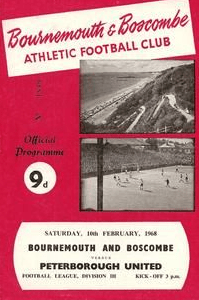
“I scored on my debut. A shot to the top left corner!” he recalls, eyes lighting up.
“On the way back to the halfway line, I asked the referee how much time was left. We had gone 3-2 up and having scored on my debut, I was wondering if I had scored the winner too.”
The match eventually ended 3-3, with Garwood substituted, but it was an encouraging start.
Towards the end of that 1967/68 season, having retained the No 7 shirt, Garwood hit a purple patch, scoring four in the last two matches of the season.
The local derby for The Posh is against The Cobblers of Northampton Town. Colin is still the only player to score a hat-trick for Peterborough United against them, as he did that afternoon. He finished the season with the opener against another relatively local opponent, Colchester United, who were demolished 1-5 at their home, Layer Road.
When he left to the London Road club to join Oldham Athletic after the end of the 1970/71 season, he was scoring at a rate of more than a goal every other game for Peterborough. This move from his local club would not be the last time that a club decided they could bring in some cash from moving Garwood on.
Colin was sold to The Latics for £10,000 where the player-manager at Boundary Park was Jimmy Frizzell, a left-back from Scotland. In his first full season, Frizzell’s team won the Third Division title, with Colin Garwood and Andy Lochhead working as a classic big man / little man double-act in attack.
Mention of Oldham prompted an aside about playing Manchester United in a pre-season match.
“I arrived at Oldham and we were told that we would be playing a friendly at The Cliff, Manchester United’s famous training ground. United still had most of their European Cup winning team from 1968. I played right wing and I was up against their number 11, George Best.
“We lost 7-0 and Best scored five. I am still not sure what we got out of that training match behind closed doors, but it was quite a thing to be up against Best and Bobby Charlton.”
Colin joined Pompey from Colchester United. He signed for what was arguably the worst team the Fratton Park fans have ever seen. Liverpool legend, Ian St. John had been unable to galvanise an ageing squad during a desperate time for the club and Jimmy Dickinson had been asked to take on the manager’s job.
“I learned that team spirit had been terrible. I was told that there had been lots of arguing, even fighting in the dressing room. Good players, like Norman Piper had been there a long time and wanted out. Some expensive players, like Paul Went, had been sold. I was bought to replace David Kemp.” Kemp was the fans’ idol.
In the season he moved to Carlisle, Kemp had scored 21 goals for a team destined for relegation. Pompey fans were beside themselves with frustration. All they had seen under John Deacon’s ownership was money spent on a team of has-beens and misfits. It was only David Kemp who offered any hope of salvation. To see him leave was soul destroying.
Jimmy Dickinson was the manager who signed Garwood for £20,000, of which 10% would be paid to the player, but it was the club Chairman John Deacon who made additional promises to help ease the deal to a close. Questions about the details of this conversation re-surfaced a few weeks later, after the new Pompey player had scored on his home debut, but was still trying to complete a house purchase just outside the city.
Deacon had offered good wages and incentives, but also there had been a clear suggestion that, additional to the traditional 10% of the transfer fee of £20,000 there would be a “tax-free” payment.
This was money that Colin had planned to use as a deposit for a house in Waterlooville, but after a couple of weeks in Hampshire, there was no sign of the agreed sum. He called a meeting with the Chairman. Frank Burrows accompanied Garwood to the meeting with Deacon, who had brought along his wife and son.
Deacon denied that there was any more money owed, but Garwood stood his ground. Mrs Deacon then leant forward on the table and asked quite pointedly, “Are you calling my husband a liar?”
With the new Garwood family home on the line, Burrows backed his player and eventually the tax-free money for the house deposit came through. Colin Garwood was then able to settle down for a bit and get on with his job of scoring goals.
I asked Colin to describe how he operated around the goal area. The few goals of his that can be found on the Internet are all quite different. A smart shot from the right and a fleet-footed move to collect a shot the keeper had spilled, that Garwood pushed away from his opponent, before spinning smartly to hook it back into the net.
To these, from my own memory I can add, a lob from about 35 yards over Port Vale’s goalkeeper, Trevor Dance on a sunny afternoon at Fratton Park and a tame shot against Walsall on a filthy, cold and wet afternoon at Fellows Park, that a kneeling Ron Green let through his hands and legs in a manner that might have been classified as an own goal, so unlikely a goal it was.
“For that goal against Port Vale, I collected the loose ball, beat about five players and then chipped the keeper from 35 yards. Frank Burrows told the press that it was worth the entrance money alone.” Garwood interjected.
All his goals seemed different, except for one factor, that of the empty space in which Garwood had found when the chance came his way.
“I can’t put it into words. Just instinct. You just know where to be. Instinct. It’s something you can’t teach.
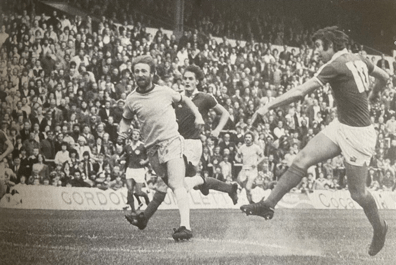
Colin Garwood finds space to shoot again. (Picture from ‘Pompey. The History of Portsmouth Football Club.’ Published by Milestones Press Ltd. Copyright: Neasom, Cooper, Robinson 1984).
“There was another I remember, when the Rochdale keeper was rolling the ball out and I was coming back up the pitch from behind him. I nicked it off his toe and stuck in the net.”
There’s certainly a lot of mystery around why some players find the net so frequently, while others cannot. Whatever the magic formula is, Colin Garwood knew it at every club he played. Which brought us around to who this nippy and sharp-witted footballer played alongside.
Garwood is recorded in the 1971-72 Rothman’s Football Year Book, as being 5’9” and weighing 10 stone 13 lbs, relatively hefty for an athlete of that height. Despite being only average height, where ever he went he scored goals and where ever he went he was teamed up with a big man up front.
At Pompey he teamed up with Derek Showers, a man of impressive build and strength, but still only 5’11”. At Peterborough his foil was six-foot Jim Hall. At Oldham, the fearsome Andy Lochhead, another six-footer, 12 stone plus, then sometimes with Tony Hateley, who although coming to the end of his long career as a centre forward, was another over six feet tall. At Huddersfield Town, Alan Gowling, (6’0”) attracted a lot of attention from defenders, allowing Colin Garwood again, to use his instincts to elude opponents and rack up the goals.
Garwood talks admiringly of playing alongside these men. Lochhead he described as the hardest man in football. He liked partnering Tony Hateley, spoke fondly of Derek Showers and Alan Gowling, in particular. While these bigger men were trading blows with the centre backs, Garwood would be picking pockets and scoring goals.
“Scoring a goal is the best feeling in sport. It’s even better when you score in front of The Fratton End.
“I scored in my first home game for Pompey, a shot to the keeper’s right. That helped get the fans on my side. Those fans are the best!” he emphasised.
“After matches I would go around the city with Eoin Hand. We would go from pub to pub, drinking with fans. They were great. I should never have left. I wanted to stay at Pompey.”
This was the time before players worked with agents. Young men, with little education in a competitive market, were prey to unfair practises of older, experienced businessmen, who thought nothing of reneging on promises after getting a signature.
David Kemp talked about this aspect of being a professional footballer in Played Up Pompey Too, Neil Allen’s second of four excellent books of interviews with former Portsmouth players.
Kemp explained his decision to leave Pompey for Carlisle was a hurried decision at the end of a transfer window. He had no advisor to help consider his options, which resulted in him missing an opportunity to play at least in Division Two, rather than simply transferring to another Division Three club, where his playing career gradually fizzled out.
Colin Garwood had some experience of moving between clubs and was not afraid to stick up for himself in negotiations, but still it wasn’t easy.
The relationships between player and the Pompey Chairman, Deacon had remained cool since those early days, although John Deacon did not get too involved with everyday matters at the club. Until one day, Garwood was called into the manager’s office to be told he was being sold, despite being top-scorer in a team with a fair chance of winning promotion from the fourth division.
£60,000 had been paid to Bury for the signature of a promising young forward, David Gregory. This was a significant sum of money that had to be recouped somehow. Selling Pompey’s current top scorer, was the resolution Deacon had set on.
A trip to Exeter was destined to fail, as Garwood did not want to go there. In fact, he did not want to go anywhere at all. Scoring goals for Pompey was all he wanted to do.
“I asked for silly money. The Exeter chairman was shocked at how much I asked for and that was that. When I got back from Devon, Deacon made a point of speaking to me. ‘You’re going to have to agree to leave. If not, you will never play for this club again.’ I was told.
“A meeting was set up with Aldershot, a fee was agreed, their club record £54,000 and I was offered good wages. I was on about £400 a week at Pompey. Everything looked set, but Pompey had still not paid all of my 10% signing on fee after my move to Fratton Park from Colchester. I insisted that I have that before leaving.”
“I returned to Pompey, but after one more game Deacon approached me in the car park, as I was about to drive home. ‘You’ve got to sign for Aldershot. I have told the manager not to pick you.’ So, I decided to sign for Aldershot.
“In the days before leaving, I got sacks of letters from the Pompey fans asking and begging me to stay. I should have stayed.”
Colin Garwood feels that Pompey was where he belonged. He had made good friends there, loved scoring goals at the Fratton End and reiterated how much he enjoyed the support of the fans, but there was some nastiness attached to his leaving.
“There was a big rumour that I was leaving so unexpectedly because of my supposedly having an affair with another player’s wife. I don’t know where that came from, maybe the club put it out to cover their tracks. It’s not true, but it’s still out there. I even saw something online a fortnight ago that said, ‘The reason Garwood left Pompey was because of an affair.’ It’s not true.
“A few months later, Portsmouth played at Aldershot. The attendance was nearly 12,000, with about 8,000 Pompey fans in the crowd. They all sang my name, all through the match. That was something. No, I shouldn’t have gone.”
As a fan, I remember the shock at his departure. Selling our leading goal-scorer, as Pompey battled to get out of a very competitive Division Four, was madness. Luckily, Pompey went up on the last day of that season in the fourth automatic promotion place, on goal difference.
“Frank Burrows was a great manager. Hard and fair. In those days you wouldn’t see much of the manager, it was the assistant manager and coaches who led the training. Frank had been assistant to Jimmy Dickinson, so we knew him well and when Jimmy was taken ill at Barnsley, we were able to carry on.”
Colin Garwood had been sat beside Dickinson when Jimmy suffered the heart-attack that led to the club’s post-war hero stepping down from the manager’s role. The club difficulties were proving too much, even for Gentleman Jim.
Frank Burrows pulled things together. He gradually recruited a new squad, using money from the sale to Brighton & Hove Albion of Steve Foster, who he had converted to a centre-back. Pompey started the 1979/80 season like a steam train, winning five matches in a row.
“Joe Laidlaw was unstoppable as captain and Peter Mellor was the keeper. There was Alan Rogers on the wing and Terry Brisley. Nearly everyone was scoring goals. It was a tremendous team to play in.” Eventually they scraped into the final automatic promotion place on the last afternoon of the season, without Garwood.

Joe Laidlaw and Terry Brisley weighing into an aerial attack.
(Picture from ‘Pompey. The History of Portsmouth Football Club.’
Published by Milestones Press Ltd. Copyright: Neasom, Cooper, Robinson 1984).
Garwood wasn’t able to join the celebrations in front of the Portsmouth Guildhall, but he collected the Division Four Golden Boot having finished the 1979/80 season as leading scorer for both Pompey and The Shots. It was some consolation for missing out on the party on the south coast.
The move to Aldershot was a real eye-opener for Garwood. The first match was away at Preston North End. After the team had checked in, Joe Jopling asked if Garwood was coming out for a drink with some of the other players. Garwood was astounded.
“We had a game the next day. Frank Burrows would have murdered any of us who had gone out on the town the night before a game. At Peterborough I would only go out on a Friday night, but only as far as visiting Tony Millington where we would have a quiet game of cards. That was our pre-match evening entertainment. I would never have dreamt of doing what the Aldershot lads did.
“They all had at least five pints that Friday night, then went to Deepdale the next afternoon and won. This wasn’t the way I was used to doing things.”
His career moved along, goals continued to go in, but at 32 years of age, with thoughts about his football career coming to an end, Colin signed for Boston United, which is on the opposite side of The Wash to Heacham, where his career had begun.
“I had just signed for Boston when I got a call from Malcolm MacDonald and Ray Harford, who had taken over the management roles at Fulham. They called too late, I had already committed to Boston. I wonder what might have been, had I known of their interest.”
Under the leadership of MacDonald and his coaches, Fulham built a reputation for quick-passing, attacking football. They were a joy to watch. Visiting Fratton Park, they scored four goals twice in two consecutive seasons. A four-all draw and a four-nil win. Their team was built to score goals and must have been very exciting to play in. They just missed out on promotion to Division One, having won promotion from the third division the year before. Colin Garwood wonders what might have been had he not signed for The Pilgrims.
A short spell as team manager in non-league with Wisbech Town after finishing playing proved to Garwood that he did not have the heart to be a manager, or coach. It was a part-time role, that he tried to fill on top of the day jobs he tried, which included forklift driving.
“Without wishing to be rude,” he said, “It is hard to coach players who can’t do what you could. Just concentrating on the basics didn’t interest me. They weren’t able to do the stuff that I had learned. It was too much for them.” Garwood admitted.
He had been in fulltime football since the age of 15 and adjusting to Civvy Street was not easy.
“I found it hard to not be playing anymore. I had it quite tough, but not as tough as some.”
He’s a modest man, but he doesn’t mind talking about making a living as a footballer and the pleasure he got from being successful.
For Colin Garwood, after the dalliance with management in non-league football, he stepped away from football. He still enjoys attending player reunions arranged at Peterborough and Portsmouth, but a career highlight was yet to come.
“One of the best days of my life was when I was invited to join the Pompey Hall of Fame. It was wonderful to be called about that honour. It was more than 30 years since I had scored my first goal at the Fratton End.”
Here was a man who had won the Third Division Championship under Jimmy Frizzell at Oldham Athletic, a significant achievement for that club, but who felt being recognised at Pompey for his part in a vital promotion, decades previously, was something extra special.
It was an absolute delight to meet Colin and his wife Jill, to hear about his football adventures. I sense that he has many more stories to share.
Although only at Fratton Park for a brief spell, few players have made such a strong impression. If you watched Pompey at any time in the period from 1977 to 1980 you were highly likely to have seen him Colin Garwood score for the club. He was much loved because of his eye for goal, but the feeling was mutual.
He closed our conversation with a heart-felt re-iteration,
“Pompey fans, they’re the best. The best!”
Maybe Pompey fans get a bit blasé about hearing such compliments from former players, but when you meet a player who has earned his living around the leagues, has enjoyed success on anybody’s terms, it does make you proud to be a Pompey fan.
~
Chris Perry
19th July 2023

 Pompey Writers