Hard Work Isn’t Always Enough

When playing cricket for Singleton in a mid-week, mid-summer evening friendly match against Langstone Wildfowlers, I found myself fielding at square leg next to Pompey’s former player and later to be First Team Coach, Andy Awford.  Andy was taking his turn as umpire, as happens in that sort of fixture.   Despite our having our respective foci on the cricket, chat between deliveries inevitably turned to Pompey.  I had seen all three of Awford’sPompey goals, which given he played 371 games for the club between 1988 and 2000, was somewhat fortunate.  

It took “Awfs” until April 1996 to score in a 2-1 away win at Watford, on what I recall was quite a tempestuous meeting of the two sets of fans.  He then took a breather for two seasons, before going on a run of two goals in two seasons, the only goal of the home win against Sheffield United in March 1999 and then again away, the following season in a 2-3 defeat at WBA.

Andy Awford was very young when he became a regular first team player at Pompey.  He had been signed from Worcester City as school boy, first playing for Pompey when still 16 years of age.

Not particularly tall for a centre-back, remarkably strong on his left foot, Awford paired up at the back with Kit Symons, in one of Pompey’s most exciting teams that I have seen here.  Under Jim Smith’s tutelage, Pompey went out of the FA Cup after a Semi-Final replay on penalties and then the following year, missed out on promotion to the Premier League having scored one fewer goals than West Ham United. 

A team total of 80 goals made following the Blues home and away, a joy.  The defence averaged one goal conceded per game, but with Guy Whittingham (46 league goals), Alan McLoughlin (12) Paul Walsh (10) and a total of fourteen players notching that season, Pompey never looked totally out a game.  Even with only nine men on the field at Sunderland, where a point would have been good enough to get promotion, or a 4-3 defeat would have been enough to get ahead of West Ham on goals scored, at 4-0 down, Pompey were magnificent.  As it turned out a 4-1 loss was the why Pompey ended up in the Play-offs, but what a day that was, as raucous and unyielding Pompey fans filled the Roker End. 

Pompey had gone to some trouble to sign the young Awford, who after his playing career, set to work as Academy Coach for the club.  In that role, he helped develop Adam Webster, Jack Whatmough, Conor Chaplin, Dan Butler, Ben Close and Alex Bass, amongst others.  From there, after a brief and vital period as First Team Coach, Andy Awford returned to Academy work, but with Luton Town, a club who have a consistently strong name in youth player development.

Every club in the world, the richest clubs most of all, are hunting for promising young players.  The biggest clubs can save a fortune by signing masses of youngsters, filtering through them and discarding many.  It is a cruel business.

Many young players have their dreams crushed at just 16 years of age, usually just before their GCSEs, when they are advised that they will not be offered a contract.  It is not just about wanting it more.  To get one exceptional player through the system, a club needs to have a squad of at least ten others in the age group to be able to put out a team for youth matches.

At the time I met Andy Awford, he was completing teacher training, but Pompey were to call again before too long.  I should have asked him, “What is the secret of developing young players?” Instead, we naturally reverted to talking Pompey and playing cricket that sunny evening.

Football is a tough business to break into. On paper, every young player has an equal chance of becoming a professional, but we all know that only a few complete that journey.  Of 1.5 million players in organised youth leagues in the UK at any one time, only about 180 of those will make it as a professional footballer.  That is a minimal success rate.

So, what should be the honest message to hopeful youth players at Pompey? Personally, I am not sure, but what I wish for each and every one of our young players is that they enjoy their time playing football at the club, make strong friendships and develop a love for the game that will last a lifetime. If one of them makes it into Pompey’s First Team Squad, all the better.

~

Chris Perry

4th June 2026

03/06/2026

At The Match

Have you ever been caught in that dilemma of work versus Pompey?  In some jobs there is flexibility to work when you want and take leave when you need, but in many lines of work leave is granted when the ship gets back to port, or if it is your turn to have a Saturday off.  

Of course, for many retail workers Saturdays, and possibly Sundays, are not available for football.  As a result, getting along to a mid-week game is a real treat for shop workers.  It is worth remembering that those attending mid-week matches are not necessarily the same people who turn out at the weekend.  For some, the first glance through the fixture list is to assess what is on mid-week, whether home or away, because these are the only games they can attend.

For those who manage to complete Saturday morning duties and get to the ground for the traditional three o’clock kick off, everything has to be carefully planned.  A glitch in a train ride, roadworks, or a mechanical issue with the car can seriously disrupt the trip.  This is equally true for those travelling from say, Hereford, Bristol, or some other fine city.  Much is made of the effort Geordies go to attend away games, but Plymouth and Pompey fans are equally respected for attending away games in good numbers, despite the mileage.  Many of today’s visitors from Norwich will have travelled for over four hours (via London if by train) to be at Fratton Park in time for kick-off.  Even their local derby match away to Ipswich is some 46 miles from home.  Hardly the walking distance that north London clubs enjoy, although the recent roadworks in East Anglia must make walking seem like an attractive alternative this season.  Is Norwich v Ipswich the furthest distant derby fixture in the land?

For the self-employed, it is sometimes true that work can be moved around to suit kick-off times, but the reality is often that getting a job done, or customers’ limited availability means being self-employed provides less flexibility on match days than one might hope.  There are many jobs well-suited to Saturday games, but less so for mid-week matches.  For those working in schools, midweek matches in half-terms are great.  These games are a good time to introduce school-age children to matches where they can experience the buzz of an evening game.  I used to love the matches in August, because they take place during the last weeks of school holidays, when going to any game was not a problem.  I particularly enjoyed the early matches on the 1979/80 season when Frank Burrows’ team were launching their successful escape from Division 4.  By contrast, for retirees, (time rich, if not financially well-off), a kick off at any time of day, or day of the week maybe a good way to shake up the stasis some experience of life after work.

Today, we have a SKY match kicking off at just after midday.  It will suit some and not others.  For those who have weddings to attend, it may even be a blessing that the game can be seen before going to a mid-afternoon ceremony.  Pompey and Ipswich hero, Ray Crawford famously got married on a match day morning, playing for Pompey that very afternoon.  A man with a well-balanced perspective on life, you might say, but he was only doing what we all do, trying to balance his private life around his job.

Whatever you do outside football, getting to the game is to be respected.  Football without fans in the ground and without away supporters is meaningless.  Enjoy the game, I’ll be listening on the radio in the van. 

One Hand Clapping 

Do you remember twenty-twenty
Trouble brewing on pub-less streets?
Do as I say, not what I do
Conspiracy theories
Fake News circulated by Tweet
Geezers need excitement
Downing Street believed
Get the football back on telly
It’s what the people need
Her Majesty’s Government’s greatest wheeze

They’re paid enough for goodness sake
For the health of the nation
Players must take the risk
Camera crews scanning immaculate grass
Millions watching through glass sat on sofas
Managers’ shouts echoing off empty seats
Lower league terraces devoid of feet
It was a daytime nightmare situation
Football played in isolation

~

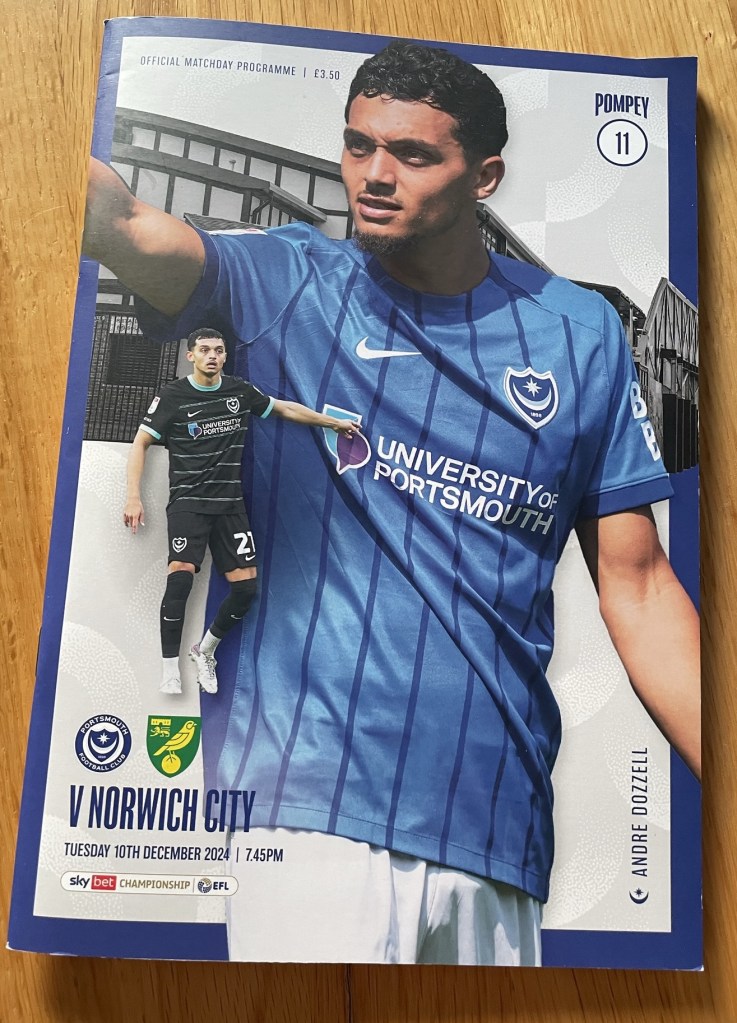
n.b. This articles was first published in the Portsmouth FC v Norwich City match programme on 10th December, 2025

Chris Perry

22nd May 2026