Lights Out

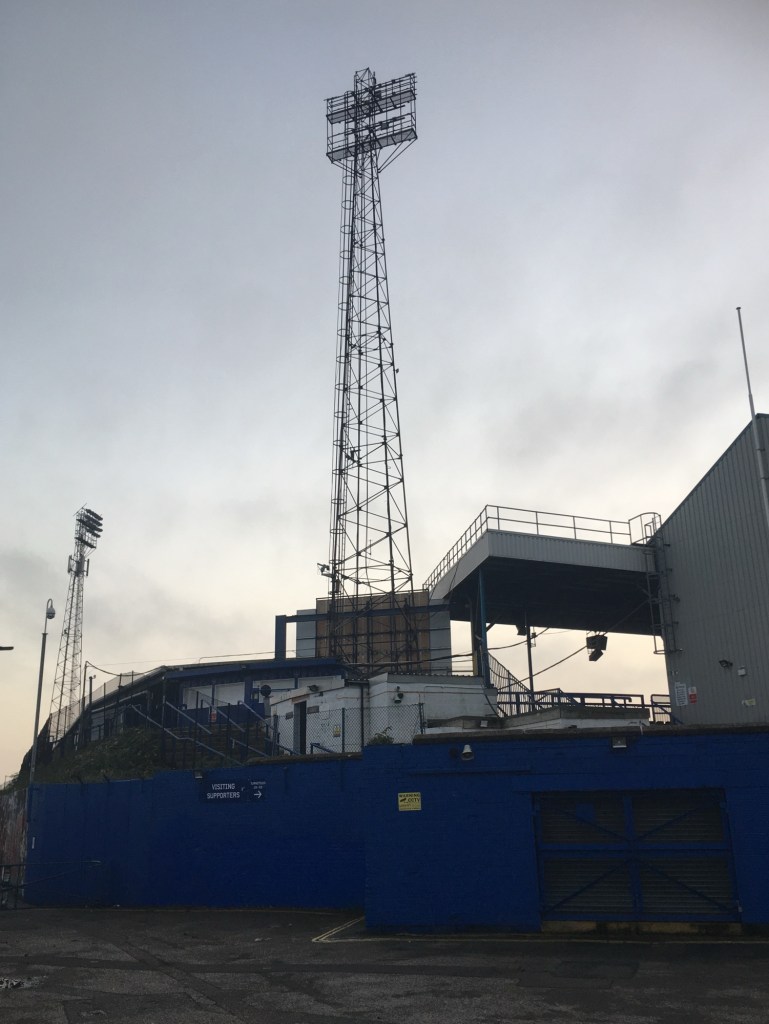
Do you travel to Pompey matches by train?  Are you old enough to remember walking over the footbridge at Fratton station, turning to your left and looking for Fratton Park, marked for nearly 60 years by four classic floodlight pylons?

For many fans using the footbridge, looking for the floodlights was a ritual, even on non-match days.  The floodlight pylons marked our spiritual home, our Mecca.  The removal of the pylons had huge symbolic significance for many.  Not least, reminding us that nothing stays the same, but also that our new owners were not going to let our ground fester.

Despite the best efforts of fan ownership, Fratton Park was fast becoming a liability, with crumbling staircases, rusting beams and shaky foundations, if there were any foundations at all at the Milton End.  Removing the floodlight pylons also eliminated a major workplace hazard.

I had often looked up the ladder of the pylon that stood at the western end of the North Terrace in awe of the height of the structure.  Who would be the person charged with climbing all the way up there to change a light bulb, I wondered.

With Portsmouth being a nautical city, there once would have been plenty of capable deck hands, experienced at clambering up the rigging and out over a spar to reef the sails in a storm, but not recently.  It would take some nerve climbing up the floodlight towers, above the concrete terrace, whatever the weather.  Before the Millennium Tower was completed, only a few, those living in the tallest tower blocks on the island, would have the privilege of enjoying such a dramatic perspective of Portsmouth, as the person charged with lightbulb replacement.

The floodlight pylons were installed during 1962 to replace lights situated on the roof of each stand. The new lights were funded by members of the Portsmouth Central Supporters Club and as such, the new structures were a dramatic symbol of Pompey fans’ commitment to their team, a commitment that was put to the ultimate test during the later financial collapse of the club.

Mark Caitlin, when CEO here, was taken aback by the many expressions of dismay that the pylons were going to be taken down.  Those pylons marked our home and in this topographically challenged city, they were something for us all to look up to.  As a result, at significant expense, a lone pylon was removed by PMC Construction and set up in a corner of the club carpark.  It still stands there, naked of any lights, a bare steel frame, looking a little forlorn, with nothing yet to acknowledge the emotional attachment that it, with its three siblings, held for so many Pompey fans. 

Originally floodlights had run along the top of Pompey’s two Leitch Stands. They would have not looked much dissimilar to the current pitch lighting arrangements.  Apparently, the original lights had a dramatic power failure during a match with Sparta of Rotterdam, that was being played to test whether professional football was practical under lights, before Fratton Park hosted the first ever Football League floodlit game against Newcastle United in 1956.

As we gathered with Millwall fans last season in excited anticipation of a keenly-awaited contest, we too suffered a power failure that meant everyone had to be sent home. This provided visiting Millwall fans the chance to sing how poor Pompey must be because, “…Southampton’s got lights!”

It was an embarrassing evening for the club, but one not of its making.  A sub-station feeding into Fratton Park, operated by the local electricity company blew up and all the frantic work of the stadium management staff to overcome the power outage was to no avail. With the return of our fierce rivals from Bermondsey, (their fourth trip here since 13th August 2024), please pay a thought for the stadium maintenance team whose work at Fratton Park is dedicated to ensuring we have a safe, well-lit and comfortable ground this afternoon, where we can watch the whole illuminated match uninterrupted.

~

Lighting Up

All the clocks have been changed
Winter gales are rolling in
By ten past four the Sun will be gone
Time to switch the floodlights on

Visible from Bognor Regis and from Ryde
Those floodlights call us back home again
Engine driver, ferry captain
Please make sure we're there on time

Cross the footbridge at Fratton station
Look left and see the bright white glow
Pompey and Millwall are at it again
Fingers crossed these lights won’t blow

There’s something special about floodlit games
The pitch is greener, the faces shine
The players shirts are much more vibrant
Our club songs shake this proud island

It’s a Saturday, close to three o’clock
The Fratton crowd is ready now
Soon the whistle will be blown
Time to get the football on

~

n.b. This article was first published in the Portsmouth FC v Millwall FC match programme on 22nd November, 2025.

Chris Perry

30th May 2026
Raise the Colours

Here we are again, playing Leeds United, an original phoenix clubs, who rose from the ashes of the infamously financially dodgy Leeds City FC. 

Known as The Peacocks for decades after formation in 1919, Leeds United either took their nickname from The Peacock Inn across the street to Elland Road, or because of the garish combinations of old gold and blue shirts worn by the team from formation until 1962.  Now the white of Real Madrid is the club colour after Don Revie imposed it, with little whisper of fan protest, while yellow and blue (the city’s official colours) have become a staple part of United’s away kits.

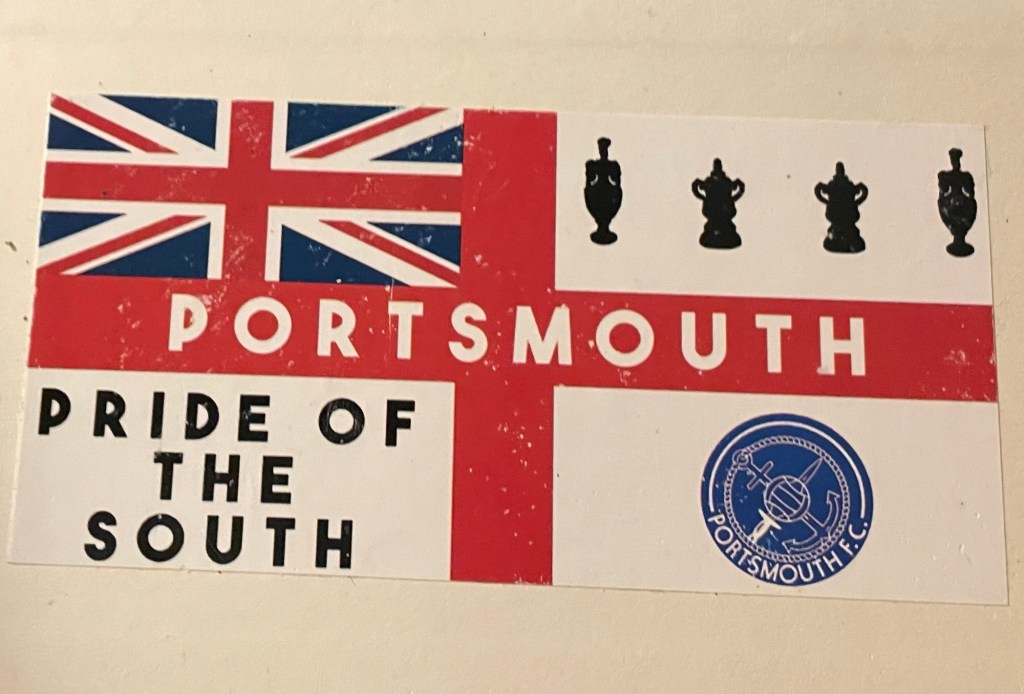
Pompey fans know how important club colours are to our identity.  Witness the row about the short-lived red Emirates sponsorship of the Millennium Tower. We are vehement defenders of the royal blue shirts, white shorts kit, with our red socks (suggested by long-time Club President, Field Marshall Montgomery) a vital, un-substitutable element. Home kits are pretty much standard these days, but Away kits and Third kits are the marketing team’s dream.

Nostalgic and historic colour schemes often prove popular, not least last season’s salmon pink of Pompey’s 125th Anniversary tribute to our first ever team kit.  Club kit designers consider whether any prospective design will be worn by supporters as leisure wear, which explains why black is often used, ignoring the fact that, from a football perspective, that a team-mate in a dark shirt will be less easy to spot than one in bright blue, white or red.

Incidentally, red has been identified by some social scientists to be the shirt colour of teams that win the most sports trophies, but this theory is clearly nonsense given the history of football in Hampshire.

The worst away kit I have ever seen was Cardiff City’s 1972/73 away kit of lilac and primrose, first worn at Fratton Park in August 1972.  On a blistering afternoon, Cardiff’s players were squinting into the Sun as it began setting between the South Stand and Fratton End.  They had taken a first-half lead from a Derek Showers goal, but as the game and heat wore on, after a Pompey equaliser from Brian Lewis, Pompey were handed the lead in bizarre circumstances.  It was the 80th minute when Cardiff won a throw-in on the South Stand touchline, in their own half.  One of their players ran over insisting he take it, so caught the ball that had been thrown toward him by his team-mate.  Referee Harold Davey (a FIFA list referee of the time) immediately ruled that the catch was handball because the throw had been made in accordance with the laws of the game.  You can imagine the complaints from the men in lilac and primrose shirts at that decision.  From the free-kick Norman Piper put Pompey ahead, to the home crowd’s cheers and laughter.  A third Pompey goal via Richie Reynolds in the 89th minute made it a 3-1 win. 

Derek Showers remembers the awful kit and the game well.  Born in 1953, Derek had grown up knowing that Pompey were one of the great teams of English football in the post-war years.  He was absolutely thrilled to have scored at Fratton Park.  He remembers floating home on a high. “After getting off the team coach at Ninian Park, I caught the train up The Rhondda to Merthyr, but because the last bus had gone, I had to walk the last mile or so to my village.  I had just scored against mighty Pompey at Fratton Park and there I was, past midnight, walking up the valley with my football boots hung over my shoulder.  ‘So much for the glamour of being a professional footballer’ I thought.” 

After joining Pompey from Bournemouth & Boscombe, when Pompey were struggling in Division 4, Showers learned how tough life as a footballer could be.

He suffered an injury that nearly cost him a leg.  As he was not a prolific goal-scorer, he suffered some vitriolic criticism from the terraces.  Despite this, the centre-forward nicknamed Nookie Bear by Pompey fans, still has brightness in his eyes when talking about playing at Fratton Park.  He had been discovered by Leeds, Juventus and Wales giant, John Charles and signed for Cardiff at 15 years of age.  Today, Derek looks fit and strong enough to still play the game for a living.  As for team kits, Showers would pull on a shirt for whoever was going to pay his wages and help keep a roof over the heads of his beloved family.

Leeds Sonnet 2024/25


Hot August day, hope stitched on our sleeves
We travelled north to take on mighty Leeds
Never thinking we might draw three – three

Graffiti, fan stickers and gable-end murals
Walking side by side with the local people
To Elland Road, their football cathedral

So good to be back in the second tier
In the bigger towns with bigger grounds
We’ll give it a fair crack, play without fear

After that heady first day, we all thought OK
We were a bit lucky, but so were they
No way will it be easy playing away

Now they’re here pushing for promotion
While we’re back home battling relegation

n.b. This article was initially published in the Portsmouth FC v Leeds United match day programme, 9th March 2025

~

Chris Perry

26/05/2026