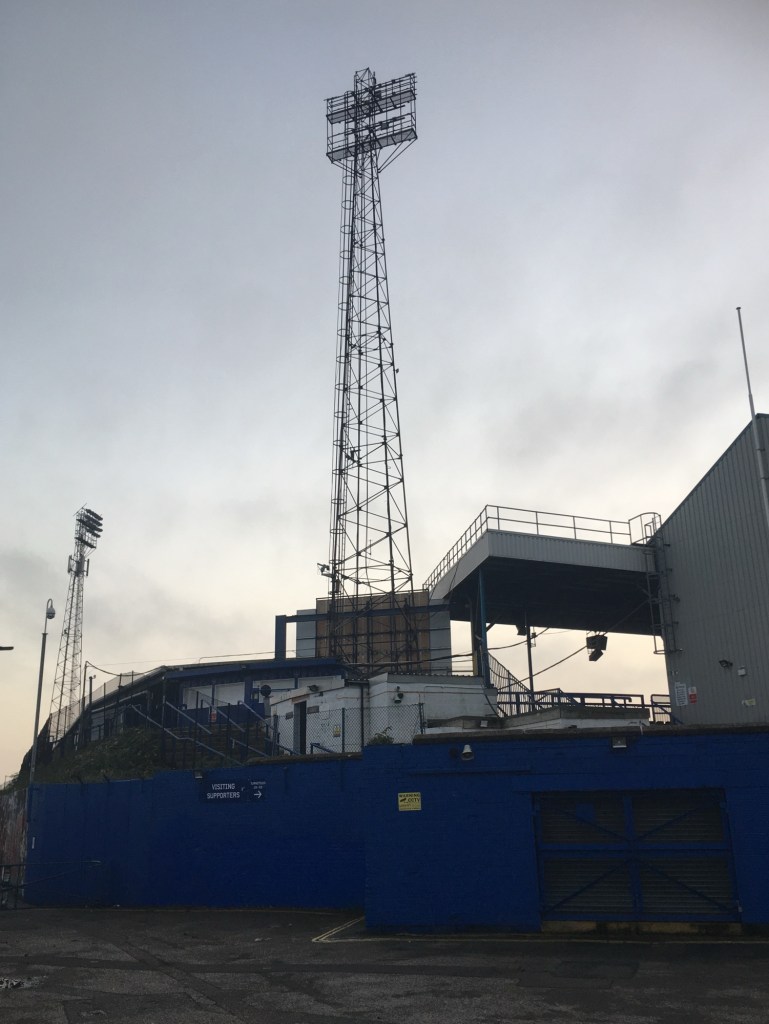
Do you travel to Pompey matches by train? Are you old enough to remember walking over the footbridge at Fratton station, turning to your left and looking for Fratton Park, marked for nearly 60 years by four classic floodlight pylons?
For many fans using the footbridge, looking for the floodlights was a ritual, even on non-match days. The floodlight pylons marked our spiritual home, our Mecca. The removal of the pylons had huge symbolic significance for many. Not least, reminding us that nothing stays the same, but also that our new owners were not going to let our ground fester.
Despite the best efforts of fan ownership, Fratton Park was fast becoming a liability, with crumbling staircases, rusting beams and shaky foundations, if there were any foundations at all at the Milton End. Removing the floodlight pylons also eliminated a major workplace hazard.
I had often looked up the ladder of the pylon that stood at the western end of the North Terrace in awe of the height of the structure. Who would be the person charged with climbing all the way up there to change a light bulb, I wondered.
With Portsmouth being a nautical city, there once would have been plenty of capable deck hands, experienced at clambering up the rigging and out over a spar to reef the sails in a storm, but not recently. It would take some nerve climbing up the floodlight towers, above the concrete terrace, whatever the weather. Before the Millennium Tower was completed, only a few, those living in the tallest tower blocks on the island, would have the privilege of enjoying such a dramatic perspective of Portsmouth, as the person charged with lightbulb replacement.
The floodlight pylons were installed during 1962 to replace lights situated on the roof of each stand. The new lights were funded by members of the Portsmouth Central Supporters Club and as such, the new structures were a dramatic symbol of Pompey fans’ commitment to their team, a commitment that was put to the ultimate test during the later financial collapse of the club.
Mark Caitlin, when CEO here, was taken aback by the many expressions of dismay that the pylons were going to be taken down. Those pylons marked our home and in this topographically challenged city, they were something for us all to look up to. As a result, at significant expense, a lone pylon was removed by PMC Construction and set up in a corner of the club carpark. It still stands there, naked of any lights, a bare steel frame, looking a little forlorn, with nothing yet to acknowledge the emotional attachment that it, with its three siblings, held for so many Pompey fans.
Originally floodlights had run along the top of Pompey’s two Leitch Stands. They would have not looked much dissimilar to the current pitch lighting arrangements. Apparently, the original lights had a dramatic power failure during a match with Sparta of Rotterdam, that was being played to test whether professional football was practical under lights, before Fratton Park hosted the first ever Football League floodlit game against Newcastle United in 1956.
As we gathered with Millwall fans last season in excited anticipation of a keenly-awaited contest, we too suffered a power failure that meant everyone had to be sent home. This provided visiting Millwall fans the chance to sing how poor Pompey must be because, “…Southampton’s got lights!”
It was an embarrassing evening for the club, but one not of its making. A sub-station feeding into Fratton Park, operated by the local electricity company blew up and all the frantic work of the stadium management staff to overcome the power outage was to no avail. With the return of our fierce rivals from Bermondsey, (their fourth trip here since 13th August 2024), please pay a thought for the stadium maintenance team whose work at Fratton Park is dedicated to ensuring we have a safe, well-lit and comfortable ground this afternoon, where we can watch the whole illuminated match uninterrupted.
~
Lighting Up

All the clocks have been changed
Winter gales are rolling in
By ten past four the Sun will be gone
Time to switch the floodlights on

Visible from Bognor Regis and from Ryde
Those floodlights call us back home again
Engine driver, ferry captain
Please make sure we're there on time

Cross the footbridge at Fratton station
Look left and see the bright white glow
Pompey and Millwall are at it again
Fingers crossed these lights won’t blow

There’s something special about floodlit games
The pitch is greener, the faces shine
The players shirts are much more vibrant
Our club songs shake this proud island

It’s a Saturday, close to three o’clock
The Fratton crowd is ready now
Soon the whistle will be blown
Time to get the football on

~
n.b. This article was first published in the Portsmouth FC v Millwall FC match programme on 22nd November, 2025.
Chris Perry
30th May 2026

