Hard Work Isn’t Always Enough

When playing cricket for Singleton in a mid-week, mid-summer evening friendly match against Langstone Wildfowlers, I found myself fielding at square leg next to Pompey’s former player and later to be First Team Coach, Andy Awford.  Andy was taking his turn as umpire, as happens in that sort of fixture.   Despite our having our respective foci on the cricket, chat between deliveries inevitably turned to Pompey.  I had seen all three of Awford’sPompey goals, which given he played 371 games for the club between 1988 and 2000, was somewhat fortunate.  

It took “Awfs” until April 1996 to score in a 2-1 away win at Watford, on what I recall was quite a tempestuous meeting of the two sets of fans.  He then took a breather for two seasons, before going on a run of two goals in two seasons, the only goal of the home win against Sheffield United in March 1999 and then again away, the following season in a 2-3 defeat at WBA.

Andy Awford was very young when he became a regular first team player at Pompey.  He had been signed from Worcester City as school boy, first playing for Pompey when still 16 years of age.

Not particularly tall for a centre-back, remarkably strong on his left foot, Awford paired up at the back with Kit Symons, in one of Pompey’s most exciting teams that I have seen here.  Under Jim Smith’s tutelage, Pompey went out of the FA Cup after a Semi-Final replay on penalties and then the following year, missed out on promotion to the Premier League having scored one fewer goals than West Ham United. 

A team total of 80 goals made following the Blues home and away, a joy.  The defence averaged one goal conceded per game, but with Guy Whittingham (46 league goals), Alan McLoughlin (12) Paul Walsh (10) and a total of fourteen players notching that season, Pompey never looked totally out a game.  Even with only nine men on the field at Sunderland, where a point would have been good enough to get promotion, or a 4-3 defeat would have been enough to get ahead of West Ham on goals scored, at 4-0 down, Pompey were magnificent.  As it turned out a 4-1 loss was the why Pompey ended up in the Play-offs, but what a day that was, as raucous and unyielding Pompey fans filled the Roker End. 

Pompey had gone to some trouble to sign the young Awford, who after his playing career, set to work as Academy Coach for the club.  In that role, he helped develop Adam Webster, Jack Whatmough, Conor Chaplin, Dan Butler, Ben Close and Alex Bass, amongst others.  From there, after a brief and vital period as First Team Coach, Andy Awford returned to Academy work, but with Luton Town, a club who have a consistently strong name in youth player development.

Every club in the world, the richest clubs most of all, are hunting for promising young players.  The biggest clubs can save a fortune by signing masses of youngsters, filtering through them and discarding many.  It is a cruel business.

Many young players have their dreams crushed at just 16 years of age, usually just before their GCSEs, when they are advised that they will not be offered a contract.  It is not just about wanting it more.  To get one exceptional player through the system, a club needs to have a squad of at least ten others in the age group to be able to put out a team for youth matches.

At the time I met Andy Awford, he was completing teacher training, but Pompey were to call again before too long.  I should have asked him, “What is the secret of developing young players?” Instead, we naturally reverted to talking Pompey and playing cricket that sunny evening.

Football is a tough business to break into. On paper, every young player has an equal chance of becoming a professional, but we all know that only a few complete that journey.  Of 1.5 million players in organised youth leagues in the UK at any one time, only about 180 of those will make it as a professional footballer.  That is a minimal success rate.

So, what should be the honest message to hopeful youth players at Pompey? Personally, I am not sure, but what I wish for each and every one of our young players is that they enjoy their time playing football at the club, make strong friendships and develop a love for the game that will last a lifetime. If one of them makes it into Pompey’s First Team Squad, all the better.

~

Chris Perry

4th June 2026

03/06/2026
Wasted at Centre-Back?

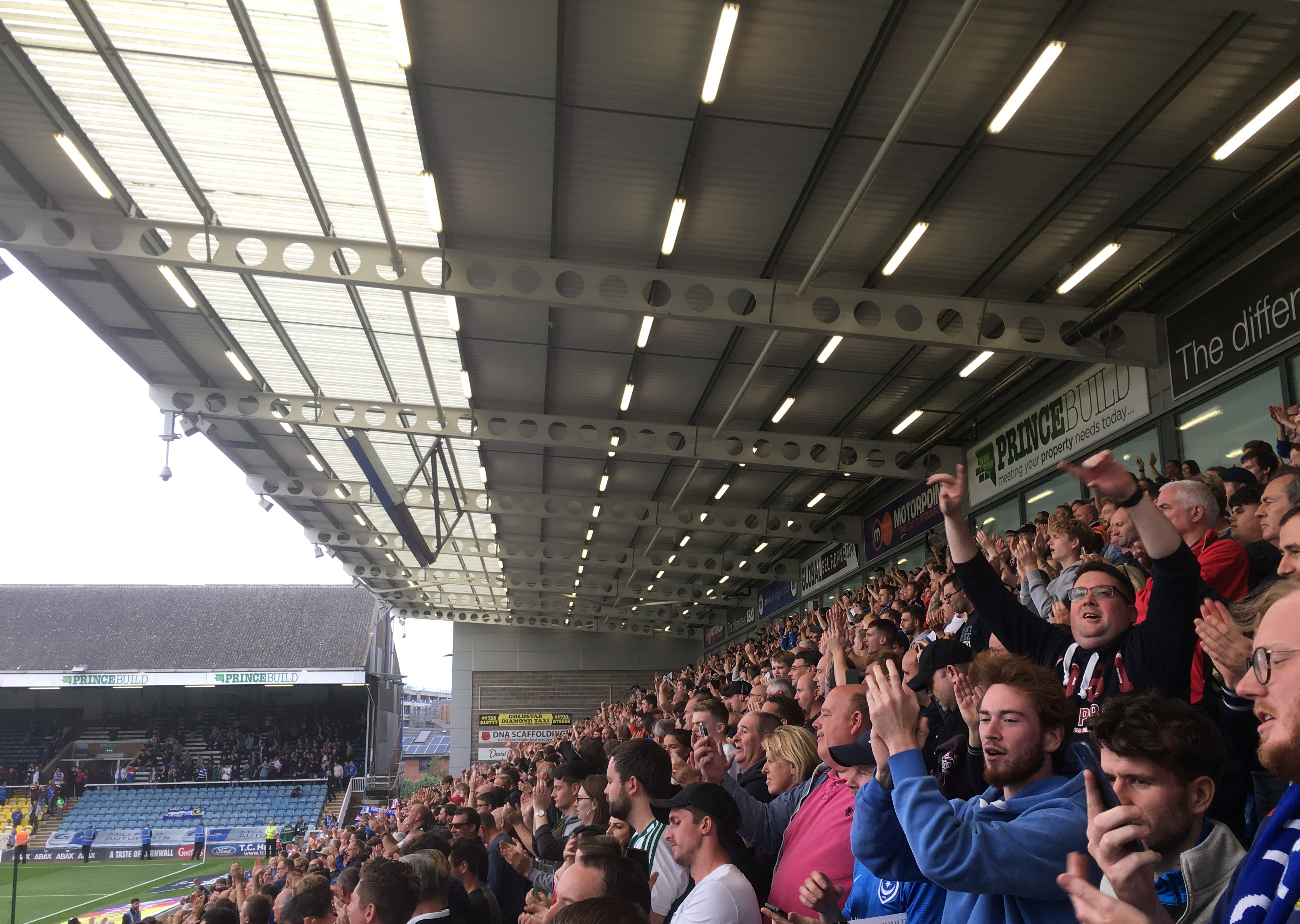
Pompey at Peterborough Sept 2018

Pompey fans ever grateful that Ipswich Town gave us Matt Clarke

Spotland, 29th September 2018. In the 81st minute Matt Clarke wins the initial header from a corner on the right. As Rochdale try to clear Clarke roughs up the player trying to play the ball out of the penalty area; he nutmegs the next closest defender then smashes the ball with his left boot across the flailing arms of the flinching home goalkeeper into the top of the goal. 3-1 and Pompey go back to the top of League One and continue their unbeaten league run.

You can see that it was a wonderful goal here on the official Pompey website. It displays the strength, skill and power of Clarke and it was celebrated wildly. It was a special goal and what made it even more special was that Clarke is a centre back, but it was not a standard centre back goal – it was a goal any footballer would be proud to score.

Despite having his right nostril stuffed with cotton wool after another facial injury, Clarke had just delivered a Worldy. There is something thrilling about seeing a central defender score a goal taken from Robert Prosinecki’s playbook of magic tricks.

BBC Radio Solent featured a lot of chat about central defenders before the Rochdale match. The talk was about the resilience needed to be a centre back. Central defenders need not be crazy like a goal-keeper, but they have to be tough; physically and mentally. What the discussion left out was the importance of centre backs scoring goals and how this lifts them beyond cult status to heroes.

Fans get a real buzz when a central defender scores a goal like Clarke’s. Headed goals from corners and free kicks, or toe-pokes from inside the six yard box are all okay. We all know the big men should get a few of those and it is part of the job description. The fun starts when the No 5, or No 6 does something out of the ordinary.

I saw all of Andy Awford’s goals for Pompey. In 313 games for the club Awfs scored at Watford, another at West Bromwich Albion and finally at home to Sheffield United. A one club man, Awford was a footballing No 6 who was not as physically imposing as traditional centre backs. After playing quietly and effectively in that position for years, he was moved into a defensive midfield role, but I always saw him as a centre back and I enjoyed his hat-trick of goals all the more for that.

Awford’s first career goal for Pompey was a right footed effort in open play from the left edge of the box in a lively 2-1 win at Vicarage Road in 1995. His goal at The Hawthorns in 1999 was particularly special because in a previous appearance at WBA he had suffered a terrible four-part leg break, so this was a revenge goal. His last goal against the Blades in a 1-0 win was a wonderful moment because it meant Awford had finally found the net at Fratton Park after first playing for Pompey over 10 seasons before.

These three goals from Awford were celebrated gleefully because they were so rare. He hit a hot streak in 1999 with his 2nd and 3rd goals coming in one calendar year, even though they were spread over two league seasons.

In his first period as manager at Fratton Park, Jim Smith had settled on a central defensive pair of Andy Awford and Kit Symons. These two were close in age and they quickly developed an understanding of the job each had to do in defence. Both were ball players, but Symons grasped soonest that scoring an occasional goal would also help his career. He scored 11 times in 204 appearances before Manchester City paid £1.2m for his services.

If you have half an hour to spare have a look at the goal Symons lashed in against Kevin Keegan’s Newcastle United in 1993. Don’t be put off by the start of the video, it interviews top of the league Geordies setting off on the coach to Fratton Park for a Tuesday night sold-out match. When the football action starts it is very entertaining and The Legend plays an absolute blinder in the second half. The Symons’ goal comes up around 13 minutes into the video. For those new to the club just have a look at the state of the “stadium” – Fratton Park is a palace today by comparison.

Although from a corner, Kit Symons’ goal that night was a right footed blaster into the top of the goal from about 10 yards after he had dropped back to get some space. As the ball came his way he adjusted his balance and waited for the ball to come to him before making perfect contact – had he missed the target there would have been injuries in the Milton Lane End. Pompey won 2-0 late in the 92/93 season.

The other Symons’ goal I vividly remember was scored when Pompey were struggling to beat relegation in 1995. Away wins were not common, so a trip to Burnley in late April with snow on the Pennines was not an enticing prospect. Pompey were playing a lot of disjointed football that season. Terry Fenwick’s knowledge and experience of international football was taking a while to get through to the squad and entertainment wasn’t part of the mix. Pompey needed to win.

I had only decided to drive up to Burnley on the morning of the match. I jumped into the family Peugeot 106 and set off up the M1 and M6 to the middle of Lancashire. Blackburn is a long way, Burnley is even further and this was before the motorway network extended that far.

I knew that I had arrived in Burnley because every petrol station, shop and public building was painted claret and blue. Is it a false memory that the zebra crossings were as well? I parked by the cricket field right next to the ground and after being stopped to be interviewed by a reporter from BBC Radio Solent, (“Do you think Pompey can win this crucial game?” “Yes.”) I went for fish and chips.

I then ended up in a WMC & Social club near the ground recommended by two members of the Northern Blues. It was 5p to get in – entry prices had been held at a shilling ever since decimalisation in 1971. Beer and cider was cheap and the bar was heaving with claret and blue shirts, but they welcomed we three Pompey fans. The Burnley fans were confident of a win.

That year 4 teams were to be relegated from the second tier as the Premier League began to apply its evil grip on the winter game. If Pompey won then they would be safe and Burnley would be unable to escape, yet in the bar all was good humoured.

In a crowd of 10,666, Pompey fans were placed on the cricket ground end of the long, covered western terrace.  Separated by steel fencing from the home supporters, we had plenty of space to dance around when John Durnin put away a first half Pompey penalty. At half-time we were 1-0 up and freezing cold. And then, as the game resumed and was becoming quite tense as Burnley pressed for an equaliser, Symons made his mark.

Collecting the ball in the Pompey half Symons set off at the flat Burnley defence who had pushed up to try and keep Pompey pinned back. He passed the ball to his left and charged on to meet the first-time wall pass from Deon Burton who was stood on the left touch line exactly on half-way. The return pass put Symons clear. The number 5 galloped on, Burnley defenders lagging behind, Marlon Beresford came off his line towards his gangly opponent.

Symons simply shimmied like a Welsh rugby winger, went to the keeper’s left and shot the ball at an angle into the empty net. Pompey 2-0 up and even after Burnley got a goal late on, the Clarets were well beaten. Symons’ solo goal came at a crucial moment in a critical fixture and it showed that the best centre backs are not just capable of keeping the opposition at bay, they can be complete footballers.

Of course there have been many other excellent goals by centre backs for Pompey. Dejan Stevanovic’s free kick versus Birmingham and Jack Whatmough’s goal at Carlisle spring to mind, but those who saw the Symons’ goal at Burnley and the Rochdale match clincher by Matt Clarke know they saw something special.

N.B. An excellent website to visit for Pompey player and match statistics is www.pompeyrama.com where I checked some of the details for this piece.

CLP  30/09/2018