The Referee’s Law Of Common Sense

I was out for a walk a couple of weeks ago and was met a man named Mervyn Cawston, who the coffee van woman said is a legend.  He was a little embarrassed by her comment, but it turns out he had played competitively against Pele.  That was when Mervyn played for Chicago Fire against New York Cosmos when Association Football was still new to the USA.

I announced myself as a Pompey fan and Mervyn perked up to tell me that he had played at Fratton Park once.  He had been sent out on loan by Norwich City to Southend United for the latter part of the 1982/83 season and played against Pompey when we had promotion from Division 3 confirmed.   I was at that game with my Golden Wonder sales colleague, John Hine, and I recalled we won 2-0.  “I think that the first goal was my fault.”  Mervyn said, before checking online for a video of highlights.  When I got home I found a ten-minute video posted from the ITV archives.

Mervyn was right, he had dropped a corner early on and the loose ball was lashed home by Kevin ‘Dead-eye’ Dillon from about ten yards.  Fratton Park nerves were initially settled by Dillon’s effort, but it took a flying header from Alan Biley at the Fratton End, late into the game to unleash the celebrations.  As the game moved toward its conclusion, the Fratton faithful edged out from terraces and lined the whole pitch.  There was no room for the ball to fully cross the line for throw-ins, but nobody encroached onto the field while the game proceeded.  The commentator, Gerald Sinstadt, became concerned that the referee was insisting on ensuing that the full ninety minutes, plus injury-time was played.  Sinstadtwondered at one point why Mr Eric Reed from Bristol, was not applying the unwritten law of common-sense to the situation.  The crowd was getting quite raucous as the clock ticked on.

Eventually, with the ball as far away from the tunnel as possible, in the corner of the Milton End and North Stand, the final whistle went and Pompey fans invaded the turf to engage in good-natured celebration.  Sinstadt’s criticism of Mr Reed was mild by modern standards, but I am sure the referee was trying to be fair to Pompey and all the other teams in Division 3 by insisting that the game was finished at the right time.  An early finish might have led to complaints about bias, or even cowardice, thus staining his refereeing reputation.  There may even have been an official enquiry, possibly a re-match that could have led to Pompey not getting promoted.  Difficult though the situation was, Mr Reed saw it through to the bitter end, ensuring fair play for all. Which is all we really want from our referees.

You can find the video by looking up ‘pompeyfanmike’ on YouTube, who has put some great material online.  Watch the Southend United highlights to the end and you will see an interview with the irrepressible Alan Biley, (who had reachedhis career highest goals in a season total with that afternoon’s header) and the club Chairman, Mr John Deacon.  It is an interview that the taxman may well have looked at twice, because when the attendance for the afternoon was asked, John Deacon said immediately and with a straight face, “Eighteen Thousand.” This crowd figure came as a surprise to me.  I had been at Fratton Park for a Division 3 match against Brighton a few years before when the crowd was 36,000 and that crowd was not much larger than for one celebrating Pompey’s promotion in 1983. Cash on the gate led to a few puzzling attendance figures being announced back then.

Mervyn was delighted to have met someonee who had been at a game he played in and I look forward to catching up with again before too long.  He’s got some great stories to share, not least about the former Pompey centre-forward, Ron Saunders, who was once Mervyn’s manager at Norwich City.

 ~

Jobsworth

A slip, a fall, a trip, a push
I’m the one who has to decide
Do I blow the whistle?
Should I let it ride?

A goal, off-side or on?
Keeping up with the back-line’s moves
Takes concentration
With the North Stand baying

I need a sense of humour
With these grown men playing
Though I know it’s their job
With mortgages to be paid

I have mine too, I‘m just saying
Me and my assistants do our best
To keep the game flowing
Come on lads, it’s only a thrown in

Ninety minutes plus added on time
Jobs depend on getting things right
But if that was a slip or that was a foul
Who’s made the error?
Was it the referee
Or the football player?

~
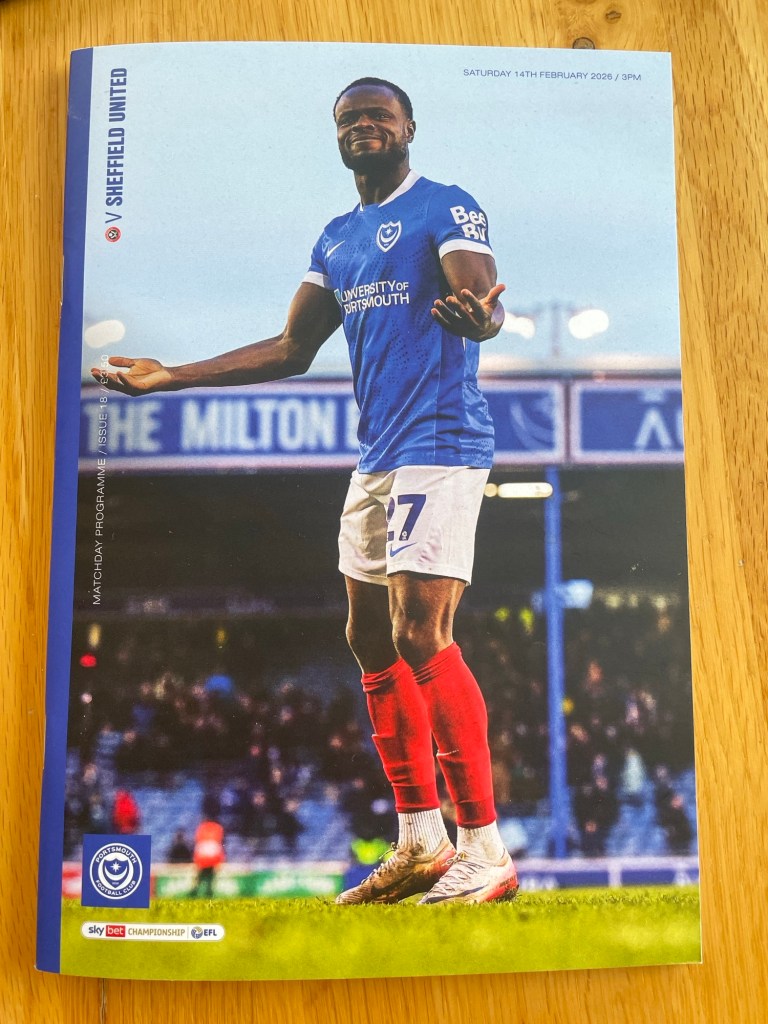
n.b This article first appeared in the Portsmouth FC v Sheffield Wednesday FC match day programme on 14th February, 2026

Chris Perry

5th June, 2026
Flagging Interest in the FIFA World Cup 2026

The 2026 FIFA World Cup, is scheduled to be hosted by the Canada, Mexico and the USA.  A second cross-border tournament, first successfully undertaken with the South Korea-Japan tournament of 2002, will present some wonderful memories for those Pompey fans who will travel to support England. Group match tickets, starting at $60, are being allocated through a world-wide lottery.  Final tickets start at $2,030 a piece.  Getting into games may well be an exercise in who you know, or meet on your travels. 

Many of us watching England on the box will also take part in the age-old parlour game of spotting the various St George’s flags from around the country.  It is always cheering to see a Pompey flag in the array of England flags ringing a foreign field.  Spotting Pompey flags at non-England matches during a major tournament gains extra points, by the way. 

Noting names of other clubs and towns on English flags is another side-show, particularly when full backs and centre backs are trading side-passes in the stifling heat of a New World summer. For example, one that caught my eye was Workington, stitched into a flag prominently displayed for the group qualifying match in Tirana, in mid-November.  

Workington AFC, located thirty-five miles south-west of Carlisle, on the Whitehaven coast, would have been a challenging away trip for any lower division team, after the club was elected to the Football League Division Three – North, replacing New Brighton in 1951.  Workington lasted in the Football League until 1976/77, when after winning just four matches that season, it was replaced by Wimbledon FC.  The club made little impression on the Football League, (apart from being a step on the way to Anfield for Bill Shankly and the launch pad for goalkeeper John Burridge’s 798 professional game career), but Workington’s supporters are still proud to support the English national side.

In a club versus country debate, my loyalties have always put Pompey first, then I’ll follow any international side that features Pompey players, past or present.  This permits me some leeway when watching a major tournament, but this year, it will be 60 years since HM Queen Elizabeth II presented Bobby Moore with the Jules Rimet Trophy at Wembley.  That steamy July day in 1966, is one of which I hold some clear memories.  My dad had bought a new black & white television, on which he watched the match with a work friend, while I was left to follow events on the older TV set in the back room.

I distinctly recall Hurst’s header, Peters sweeping the ball home for England’s second and then Geoff Hurst’s thumping third that settled the match beyond all doubt, ensuring that there would be no replay had West Germany equalised again.

Of the controversy about the ball which did not cross the line, or the scrambled 90th minute West German equaliser, I cannot not recall.  I do remember by first brother wandering away bored from the TV, and going up to his room during the match to play with the Lego.  At the time I questioned his commitment to the beautiful game.   If he couldn’t sit through a World Cup Final, how would he ever be a proper football fan, I wondered. He had celebrated his fifth birthday a couple of weeks previously, old enough for school, so old enough to know about football, I reckoned, already being a world-weary six-and-a-half-year-old myself.

Geoff Hurst is still my hero for his three goals in 1966, but it was twenty-one-year-old Alan Ball, who ran the show that day. If you watch a recording of the match, you will see the player, who was to become a famous Pompey manager, run non-stop for the team that World Cup Final day.  He was a vital cog in Alf Ramsey’s ‘Wingless Wonders’ winning formation.  No Pompey fan watching in ’66 could have dreamt that the little guy wearing the No 7 for England would be the man to steer Pompey up to the top Division for the first time in twenty-eight years.

Here’s a game of imagination for you to try, while watching the FIFA tournament whittle forty-eight teams down to the final two, consider who of all the players you see, see if you can spot one who one day may become a member of the Pompey family.

~

The Seven Stages of An International Career
All the world cup’s a pitch And all the men and women merely players

They have their appearances and their substitutions

And one man in his career plays many parts

His games being in several parts.  At first the debutant

In awe of his team-mates, who know the score

And then the unused substitute skipping and stretching

Shining with enthusiasm, trying to catch the coach’s eye To get on the pitch,

And then the player, Growling like a lion, during the national anthem

Sung with patriotic passion.  Then a hardened pro

Full of feints and moves, making the killer pass

United in loyalty, sudden and quick in a challenge

Seeking the winner’s reputation

Even in time added on for stoppages. And then the coach

In fair round belly with peaked cap on With eyes severe and beard of formal cut

Full of wise tactics and modern formations

And so he plays his part. The sixth age shifts

Into the sad and slipper’d panel pundit

With spectacles on nose and on the couch, side on;

His too young clothes, well sav’d, the screen too wide

For his shrunk name and his big manly voice

Turning again toward petty gripes

Complaints of VAR and referees’

Unfair whistles.  Last game of all

That ends this strange, eventful career

Is with child-like enthusiasm and mere oblivion

Sans shirt, sans club, avec memories et medals.

 ~

(with apologies to W Shakespeare)

~

n.b. This article was first published in a Portsmouth match day programme, details tba.

Chris Perry

02/05/2026

Lights Out

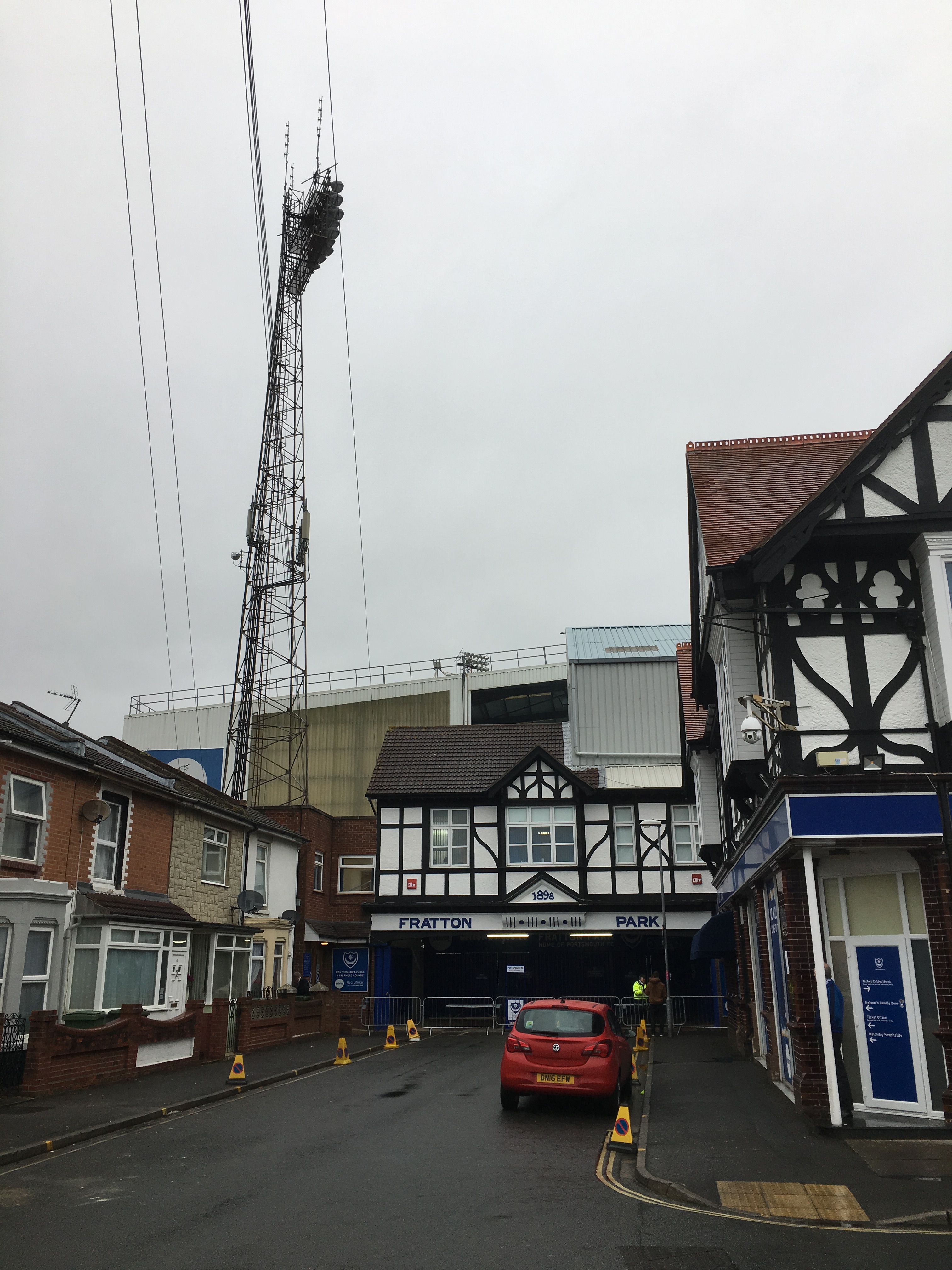
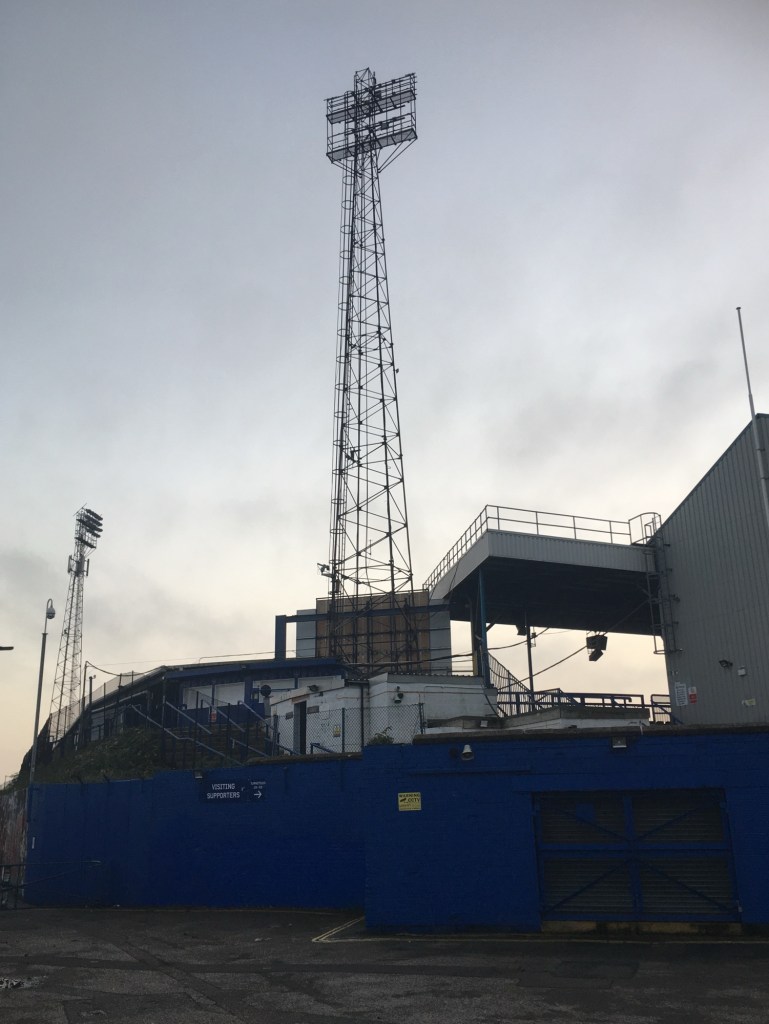
Do you travel to Pompey matches by train?  Are you old enough to remember walking over the footbridge at Fratton station, turning to your left and looking for Fratton Park, marked for nearly 60 years by four classic floodlight pylons?

For many fans using the footbridge, looking for the floodlights was a ritual, even on non-match days.  The floodlight pylons marked our spiritual home, our Mecca.  The removal of the pylons had huge symbolic significance for many.  Not least, reminding us that nothing stays the same, but also that our new owners were not going to let our ground fester.

Despite the best efforts of fan ownership, Fratton Park was fast becoming a liability, with crumbling staircases, rusting beams and shaky foundations, if there were any foundations at all at the Milton End.  Removing the floodlight pylons also eliminated a major workplace hazard.

I had often looked up the ladder of the pylon that stood at the western end of the North Terrace in awe of the height of the structure.  Who would be the person charged with climbing all the way up there to change a light bulb, I wondered.

With Portsmouth being a nautical city, there once would have been plenty of capable deck hands, experienced at clambering up the rigging and out over a spar to reef the sails in a storm, but not recently.  It would take some nerve climbing up the floodlight towers, above the concrete terrace, whatever the weather.  Before the Millennium Tower was completed, only a few, those living in the tallest tower blocks on the island, would have the privilege of enjoying such a dramatic perspective of Portsmouth, as the person charged with lightbulb replacement.

The floodlight pylons were installed during 1962 to replace lights situated on the roof of each stand. The new lights were funded by members of the Portsmouth Central Supporters Club and as such, the new structures were a dramatic symbol of Pompey fans’ commitment to their team, a commitment that was put to the ultimate test during the later financial collapse of the club.

Mark Caitlin, when CEO here, was taken aback by the many expressions of dismay that the pylons were going to be taken down.  Those pylons marked our home and in this topographically challenged city, they were something for us all to look up to.  As a result, at significant expense, a lone pylon was removed by PMC Construction and set up in a corner of the club carpark.  It still stands there, naked of any lights, a bare steel frame, looking a little forlorn, with nothing yet to acknowledge the emotional attachment that it, with its three siblings, held for so many Pompey fans. 

Originally floodlights had run along the top of Pompey’s two Leitch Stands. They would have not looked much dissimilar to the current pitch lighting arrangements.  Apparently, the original lights had a dramatic power failure during a match with Sparta of Rotterdam, that was being played to test whether professional football was practical under lights, before Fratton Park hosted the first ever Football League floodlit game against Newcastle United in 1956.

As we gathered with Millwall fans last season in excited anticipation of a keenly-awaited contest, we too suffered a power failure that meant everyone had to be sent home. This provided visiting Millwall fans the chance to sing how poor Pompey must be because, “…Southampton’s got lights!”

It was an embarrassing evening for the club, but one not of its making.  A sub-station feeding into Fratton Park, operated by the local electricity company blew up and all the frantic work of the stadium management staff to overcome the power outage was to no avail. With the return of our fierce rivals from Bermondsey, (their fourth trip here since 13th August 2024), please pay a thought for the stadium maintenance team whose work at Fratton Park is dedicated to ensuring we have a safe, well-lit and comfortable ground this afternoon, where we can watch the whole illuminated match uninterrupted.

~

Lighting Up

All the clocks have been changed
Winter gales are rolling in
By ten past four the Sun will be gone
Time to switch the floodlights on

Visible from Bognor Regis and from Ryde
Those floodlights call us back home again
Engine driver, ferry captain
Please make sure we're there on time

Cross the footbridge at Fratton station
Look left and see the bright white glow
Pompey and Millwall are at it again
Fingers crossed these lights won’t blow

There’s something special about floodlit games
The pitch is greener, the faces shine
The players shirts are much more vibrant
Our club songs shake this proud island

It’s a Saturday, close to three o’clock
The Fratton crowd is ready now
Soon the whistle will be blown
Time to get the football on

~

n.b. This article was first published in the Portsmouth FC v Millwall FC match programme on 22nd November, 2025.

Chris Perry

30th May 2026

The Non-Attenders

“There is nothing like football is there?  Nothing can make you feel every emotion like a football match.”  Kevin Maybe.

Portsmouth is the most densely populated city in the United Kingdom.  The latest data calculated the population to be 208,100.   As a seated stadium, the largest crowd here was in 2009 versus Spurs when 20,821 pitched up.  That equates to about 10% of the total island city population, although many Pompey fans don’t live in the city.  When Pompey played Derby in the FA Cup in 1951, the crowd was more than 20%, one-in-five of the city’s residents.  Imagine!  Every fifth person in the city going to Fratton Park. It is hard to believe that possible.

I knew a man who proudly told me he was there in 1951, although I am more impressed now if someone boasts of being in the crowd of 1,200 versus Bristol Rovers in the 2016 EFL Trophy match, which was Pompey’s smallest crowd since 1946.

Have you ever wondered about the 90% of the city’s people who don’t go to Pompey matches?  What are they doing?  Up at the QA on Portsdown Hill, there are some wards that overlook the city from which the lights of Fratton Park are clearly visible.  Up there, patients are able to listen to Pompey’s home matches on the QA Hospital Radio via the Pompey Audio Description commentary service.

This service was initially set up in the 2015/16 season in partnership with the Portsmouth Disabled Supporters Association to bring match commentary to partially sighted Pompey fans at Fratton Park, but has now been wired into the QA Hospital Radio service.  Why not just listen to the BBC Radio Solent service, you might ask?  Well many patients may do, but the Audio Description service commentators are specifically trained to describe the action non-stop, with the asides and chat saved for pre-match and half-time, so that listeners know exactly what is happening, as it happens.  It is detailed commentary, focusing precisely on where the ball is and what the players are doing.

A couple of the original Pompey AD commentators are now working for national radio and other TV stations, as the current dedicated team certainly could be, given the great service they provide to their listeners.

Besides Pompey fans too unwell to attend, there are a large number of people in Portsmouth who are freed up to enjoy a bit of personal space, while one, or more of their household is down at ‘The Park.’  My grandmother would settle into an armchair with a cuppa and watch the wrestling on ITV during Saturday afternoons, while my grandfather was at football.  Some people go down to Gunwharf Quays, (or Gunwharf Queues as I call it), for some shopping, meaning many people have to be there working too, to take their money.  

Some people of nervous disposition cannot go to games due to the anxiety a Pompey game can bring on.  My grandfather’s doctor told him to stop going to games because his heart was no longer up to the strain, which sadly turned out to be true, although he was spared watching Pompey ever playing in Division 4, which was a blessing of sorts.

In Nick Hornby’s first book Fever Pitch, he writes of his dream of buying a house next to Highbury, which came true due to the sales success of his book. As a result he could just pop out the door to watch his beloved Arsenal, but then they moved to a new stadium down the road, but not too far.  I wonder how many of Pompey’s neighbours have achieved the local equivalent, fulfilling a lifetime’s ambition by living next door to Fratton Park?

For other neighbours, matchdays might be the worst day of the fortnight.  What with the crowds roaring, parking restrictions, police horse dung in the street, match days might be days to go off the island and walk on the Downs, or the beach at The Witterings, although from both you can still see the glow of the lights (as you can from the Bognor Regis prom).  In the 1940s and 50s, some of the neighbours used to charge 6d to look after the bicycles of fans, so making a bit of pocket money from the gathering throng.

A poem by Rebecca Loveday, captures the excitement and anxiety of watching Pompey hang onto a one-nil lead against Leeds United, as the final minutes are played out.  Early leavers may just be following doctor’s orders, but for many, this is when the drama and sheer joy of attending is most keenly felt, which is exactly why they are here in the first place.

~

n.b. This article, with Rebecca Loveday’s poem, was first published in the Portsmouth FC v Wrexham FC match programme on 5th November, 2026.

Chris Perry

29/05/2026


Raise the Colours

Here we are again, playing Leeds United, an original phoenix clubs, who rose from the ashes of the infamously financially dodgy Leeds City FC. 

Known as The Peacocks for decades after formation in 1919, Leeds United either took their nickname from The Peacock Inn across the street to Elland Road, or because of the garish combinations of old gold and blue shirts worn by the team from formation until 1962.  Now the white of Real Madrid is the club colour after Don Revie imposed it, with little whisper of fan protest, while yellow and blue (the city’s official colours) have become a staple part of United’s away kits.

Pompey fans know how important club colours are to our identity.  Witness the row about the short-lived red Emirates sponsorship of the Millennium Tower. We are vehement defenders of the royal blue shirts, white shorts kit, with our red socks (suggested by long-time Club President, Field Marshall Montgomery) a vital, un-substitutable element. Home kits are pretty much standard these days, but Away kits and Third kits are the marketing team’s dream.

Nostalgic and historic colour schemes often prove popular, not least last season’s salmon pink of Pompey’s 125th Anniversary tribute to our first ever team kit.  Club kit designers consider whether any prospective design will be worn by supporters as leisure wear, which explains why black is often used, ignoring the fact that, from a football perspective, that a team-mate in a dark shirt will be less easy to spot than one in bright blue, white or red.

Incidentally, red has been identified by some social scientists to be the shirt colour of teams that win the most sports trophies, but this theory is clearly nonsense given the history of football in Hampshire.

The worst away kit I have ever seen was Cardiff City’s 1972/73 away kit of lilac and primrose, first worn at Fratton Park in August 1972.  On a blistering afternoon, Cardiff’s players were squinting into the Sun as it began setting between the South Stand and Fratton End.  They had taken a first-half lead from a Derek Showers goal, but as the game and heat wore on, after a Pompey equaliser from Brian Lewis, Pompey were handed the lead in bizarre circumstances.  It was the 80th minute when Cardiff won a throw-in on the South Stand touchline, in their own half.  One of their players ran over insisting he take it, so caught the ball that had been thrown toward him by his team-mate.  Referee Harold Davey (a FIFA list referee of the time) immediately ruled that the catch was handball because the throw had been made in accordance with the laws of the game.  You can imagine the complaints from the men in lilac and primrose shirts at that decision.  From the free-kick Norman Piper put Pompey ahead, to the home crowd’s cheers and laughter.  A third Pompey goal via Richie Reynolds in the 89th minute made it a 3-1 win. 

Derek Showers remembers the awful kit and the game well.  Born in 1953, Derek had grown up knowing that Pompey were one of the great teams of English football in the post-war years.  He was absolutely thrilled to have scored at Fratton Park.  He remembers floating home on a high. “After getting off the team coach at Ninian Park, I caught the train up The Rhondda to Merthyr, but because the last bus had gone, I had to walk the last mile or so to my village.  I had just scored against mighty Pompey at Fratton Park and there I was, past midnight, walking up the valley with my football boots hung over my shoulder.  ‘So much for the glamour of being a professional footballer’ I thought.” 

After joining Pompey from Bournemouth & Boscombe, when Pompey were struggling in Division 4, Showers learned how tough life as a footballer could be.

He suffered an injury that nearly cost him a leg.  As he was not a prolific goal-scorer, he suffered some vitriolic criticism from the terraces.  Despite this, the centre-forward nicknamed Nookie Bear by Pompey fans, still has brightness in his eyes when talking about playing at Fratton Park.  He had been discovered by Leeds, Juventus and Wales giant, John Charles and signed for Cardiff at 15 years of age.  Today, Derek looks fit and strong enough to still play the game for a living.  As for team kits, Showers would pull on a shirt for whoever was going to pay his wages and help keep a roof over the heads of his beloved family.

Leeds Sonnet 2024/25


Hot August day, hope stitched on our sleeves
We travelled north to take on mighty Leeds
Never thinking we might draw three – three

Graffiti, fan stickers and gable-end murals
Walking side by side with the local people
To Elland Road, their football cathedral

So good to be back in the second tier
In the bigger towns with bigger grounds
We’ll give it a fair crack, play without fear

After that heady first day, we all thought OK
We were a bit lucky, but so were they
No way will it be easy playing away

Now they’re here pushing for promotion
While we’re back home battling relegation

n.b. This article was initially published in the Portsmouth FC v Leeds United match day programme, 9th March 2025

~

Chris Perry

26/05/2026


Having Your End Away

IMG_6388

Thinking of moving? Think carefully before leaving home.

When Wycombe Wanderers picked up their chairs in 1990 and re-located from Loakes Park, just underneath the windows of Wycombe Hospital, to the very dead-end of Hillbottom Road, the club made one good decision; keep it simple – two ends, two sides.

Despite building a main stand that looms disproportionately over the ground beneath the Chiltern Hills, the beech trees and the watchful eye of Red Kites, the club still has a home end. It has a terrace for standing and enough space for a bit of moving around when its cold in that old chalk pit. The new home end has a roof that helps send out the singing and chants into the Buckinghamshire skies. It is not a very big home end, but it is a home end.

Quite a few new football grounds have appeared on the outskirts of towns in the last few years, some better than others. In the past month I have been to two that have provoked argument about whether new grounds are better than our home at Fratton Park.

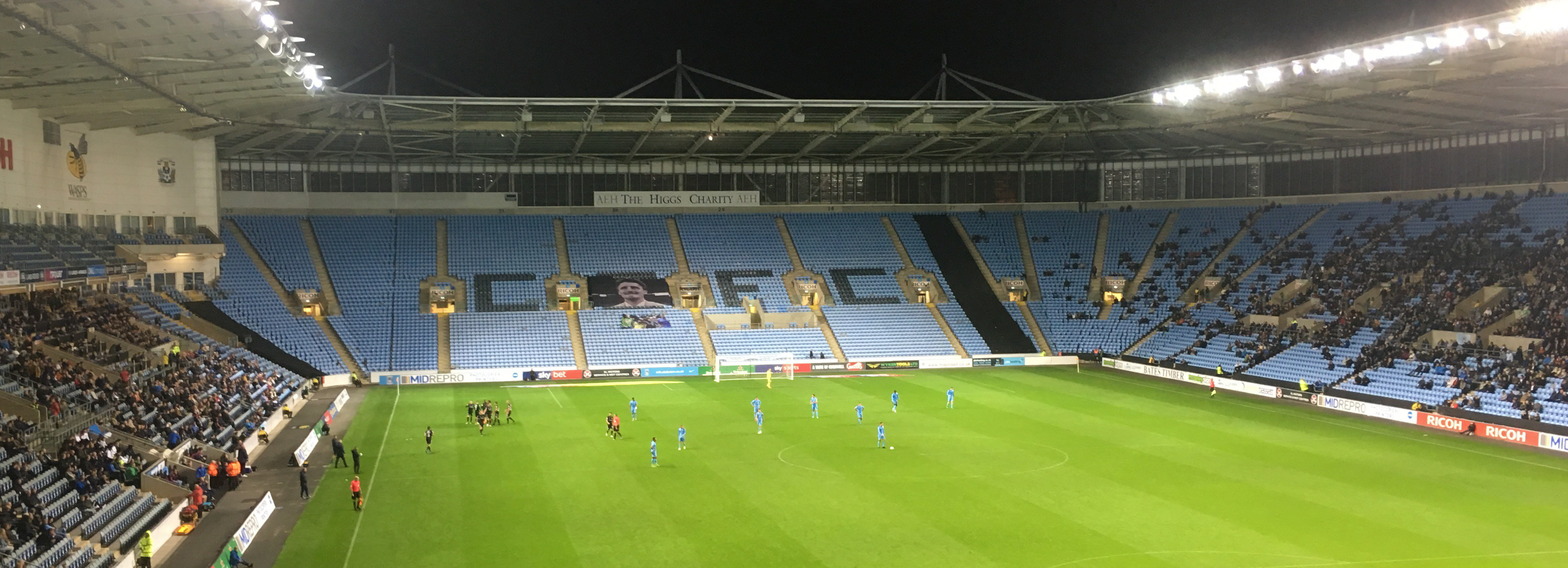
The first thing I noticed in walking around the outside of the two stadiums was how much space is taken up by the new stadia. At the Ricoh Arena, home to Wasps Rugby Football Club and Coventry City FC, (tenants listed by size of average attendance), I suspect that the footprint of this facility is close to three times the size of the playing surface. The development includes hotel and conference facilities, a vast array of catering options, an indoor sports hall with a 12,000 capacity (that is also used for gigs and shows), and a casino. Football is a sideline.

The casino is an interesting element. During Pompey’s visit on 2nd October, a fellow supporter said, “Everyone was in the casino.”  (which raises concerns about his ability to count and also makes him an ideal candidate for the Black Jack table). Personally I am totally against such places. Money takes enough sweat to earn, so why chuck it away when you could spend it on a Pompey home game?

Inside the Coventry complex, behind neon signs and towering cliffs of plastic cladding is a football pitch and seating for crowds in excess of 32,000. When talk turns to visualising an ideal ground, (a regular topic in the queues for loos at Fratton Park, or the cosy crush in the South Stand Upper concourse), capacity is often discussed, along with sight-lines and toilet queues and drains.

The space behind the stands at the Ricoh Arena is impressive. The choice of Pompey videos to entertain visitors at the bars was thoughtful, the toilet queue non-existent. Overall not an unpleasant setting to visit. I also thought that the angle of the stand, (it seemed quite steep), helped The Blue Army produce a great sound that evening. So what was the problem?

The problem was trying to spot the home fans, (“Ultras” as Palace fans like to say in their sophisticated South London way). Where were the home fans?

As it turned out the home fans were located to the right of Pompey section and so had no chance of making any dent in the Pompey Wall of Sound. The other end of the ground was taken up by a vast empty shrine to the late Jimmy Hill with no-one but ball boys in attendance. It was left to visitors from Portsmouth to bring our own atmosphere and help entertain the locals.

So here’s the problem; in a more rounded stadium, where do home fans gather? How is the atmosphere built, sustained and maintained? Fratton Park can be an intimidating prospect for visiting teams, but could we keep that if we were to ever move?

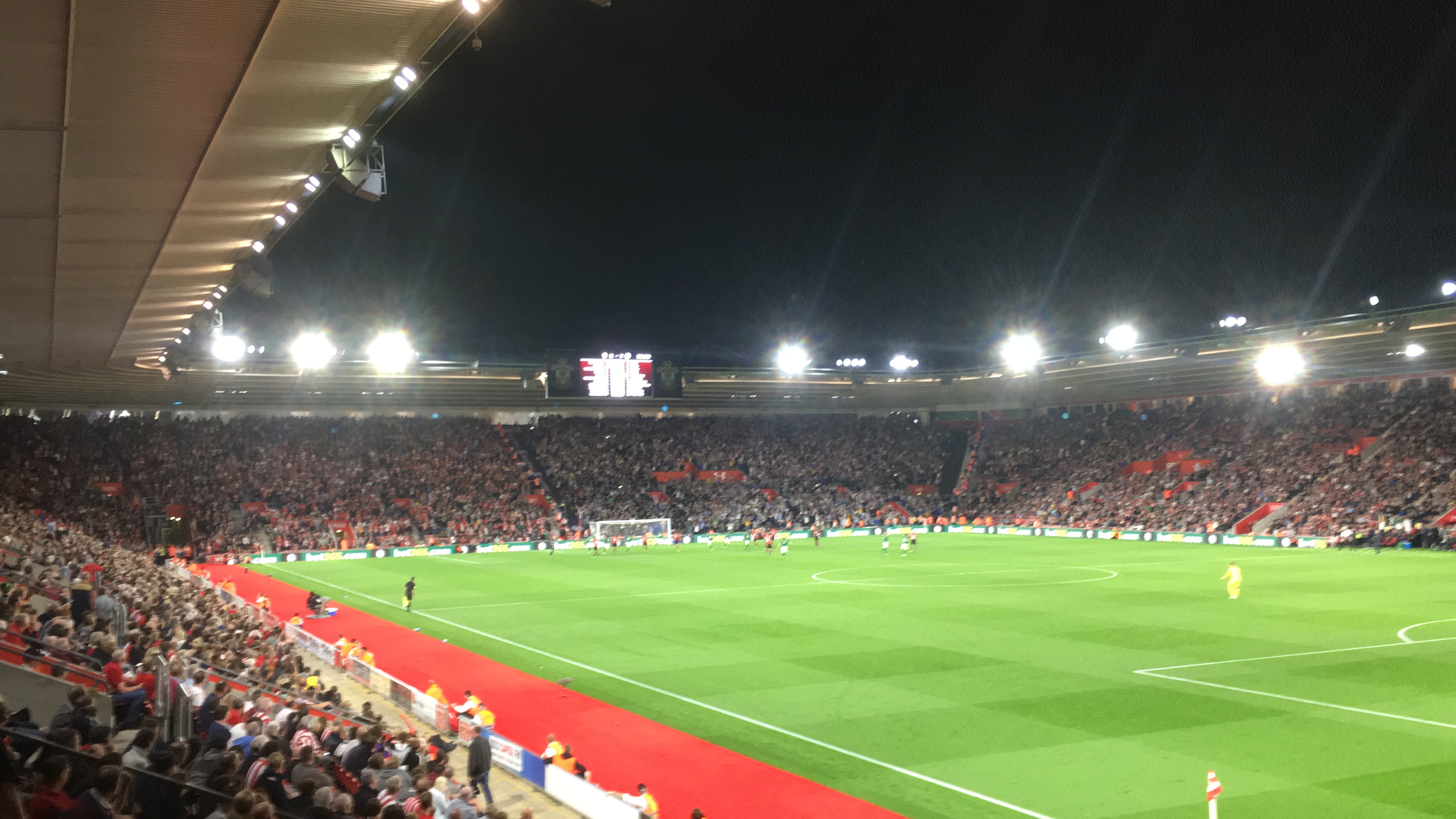
I was working down the road just the other day. It was a match day and walking around that plastic stadium I was again struck at how much space a new ground takes up. This one, opened in 2001 it has at least two major flaws (some might say 30,000 flaws, but we’ll discuss that another time).

The first issue is that it is laid out from goal to goal on an East – West line.  With the sun low in the sky the Northam End, where visiting fans are placed, can be bathed in blinding sunlight. Many Pompey fans will remember a ridiculous mid-winter sunny midday kickoff when it was impossible to see what was happening for much of our 0-3 defeat (thankfully). When building an open-air sports facility, make sure to check where the sun is during the winter football season, i.e. usually low in the sky and following a rough east-west trajectory.

IMG_9697

RCD Espanyol where a kickoff before sunset would disturb the afternoon siesta

The second problem is the lack of an end for the home fans and the subsequent loss of atmosphere. At the Chapel End there is the family section with all its weird cartoon characters, (in addition to children’s entertainment and clowns dressed up as mascots).  This family section is as far away as possible from visiting supporters so they are less likely to witness any off-putting scenes close up, such as Pompey fans celebrating spectacular last minute goals. (Click link for gratuitous You Tube clip of a random David Norris effort).

47992F4A-8BEB-4436-8AB4-0C6B6982FC88

Distant view of Brighton fans on a Big Night Out

So if the family section takes up much of one end, do the Ultras spread out into the stands or, do they have to compete for an end with their guests? When I say compete, I mean try to out-sing, out-chant; the kind of thing that builds an atmosphere.

As Pompey fans most of us will have only ever been at this particular ground when 27,000 people are united in their bilious hatred of 3,000 of us, but on normal match days the atmosphere is very different. The crowd only unites and makes a bit of noise when things are going well – just like White Hart Lane. Besides the obvious, why is this? I think it’s because no one knows where the home end is; there is none. Without a concentrated end of fans doing all the blind-faith things they do we could be reduced to plastic clappers (as Sc*m have used), goal music (Urgh! Wolves?) or blokes with loudspeakers (any French Ligue 1 ground) to try and get the fans going.

This is a problem created by poor ground design. Too many new grounds have been  developed with money making in mind and not football as a priority. I believe that our friends from the USA see this is a major challenge in developing better facilities for Pompey fans. Pompey has to be a sustainable venture financially, operating competitively, but it will mean nothing if we become another Bolton Wanderers who play their games in an empty, soul-less concrete bowl out of reach of the local town, near the motorway, with reduced gates and little to shout about.

So if you have a bit of money to spend on a new home, yes, make sure that there is enough space, but absolutely definitely, without fail, make sure that there is a home end, none of this half-baked good site lines, nice catering, decent toilets, lovely hotel and a casino nonsense. Those are the extras, not what makes supporting Pompey so special.

CLP  08/10/2018

“How to be a Footballer” by Peter Crouch

E935B2C3-88AF-4494-9E54-0EAD3F46B9DE

Fratton Park just two stops on the carousel of Peter Crouch’s football career.

For those of you interested in books by former employees of Pompey, this one may be worth a look. It is currently half-price in Waterstones (at at 12th September, 2018), representing a saving of £10 for a hardback copy. However, this is not a book review, just my excuse to write about Peter Crouch, a player I had great respect for during his two contracts at Pompey at Championship and Premier League levels.

Crouch was originally bought by Pompey from QPR for £1.5m in 2001. It was at QPR that he had first signed as a school boy before going to Spurs as youth player and then being sold back to QPR for £50,000.  This was the first inkling that he was a player happy to move back and forth between clubs if it meant he would get a game. He later returned to Pompey after a while at Aston Villa (sold there by Pompey for £5m in 2002); via a loan trip to Norwich; a transfer to the west Hampshire club now owned 80% by Gao Jisheng;  then Liverpool who paid £7m to sign him and then back to Fratton Park for £11m in 2008. Crouchy was then transferred for £10m to Spurs. Clearly a popular worker to have been welcomed back by so many former employers.

Is there any other top league player who has been able to dance between clubs with such agility? That he also had a spell at Chelsea as a ball boy, despite supporting QPR, suggests he gives a good interview.

My first memory of seeing Crouch playing was from 4th February 2000 in the 1-1 draw away at QPR. The young centre forward proved to be a challenge for the Pompey defence that afternoon and the QPR fans protested shrilly at the rough treatment their No 9  received  at the hands, knees and elbows of player-manager Steve Claridge’s team. Despite Crouch’s spindly frame and light-weight, there was something about the timing of his jumps and his ability to hold and lay the ball off that was impressive. He did very well in the first half and was unlucky not to score, but nodded the ball down to Paul Peschisolido for the early QPR goal. The other thing that impressed me that afternoon was that he actually finished the game, showing great determination and grit despite the battering he was getting.

In the second half, before or just after Lee Bradbury’s equaliser (I can’t remember precisely), there was a tangle of limbs and Crouch fell to the ground in a pile with Darren Moore. Both players were a little off balance, QPR fans howled for a penalty and became even more incensed as the massive frame of the centre-back Moore clambered to his feet, made a slight stumble and had to kneel on Crouch’s ribcage to return to standing. Needless to say Crouch didn’t move very far for a while.

I am pretty certain that Crouch lost his effectiveness in this game at that point, but the 19 year old soldiered on. The BBC match report mentions that Crouch was lucky not to get a red card for a late tackle towards the end of the game, likely the frustration of being bullied by Darren Moore for 90 minutes finally getting to him. However, the youngster stuck it out.

I did not previously know that Peter Crouch played for Dulwich Hamlet and IFK Hassellholm on loan when first at Spurs – at least in Sweden at 6’7″ he would have felt as if he was a normal height. Apparently he went on loan with Alton Therwell to Sweden as part of a £70,000 transfer arrangement for Jon Jonsson who was wanted by Spurs. I had never heard of Alton Therwell, nor Jon Jonsson before I researched this article, so Crouch has a head start on these two when writing a book called, “How to be a Footballer.”

Other memorable moments from the career of Peter Crouch that I recall are his scoring a last minute winning penalty against us in an outrageously badly refereed FA Cup game in west Hampshire, (when Matt Taylor was so unfairly penalised for the ball hitting the point of his shoulder); two extra time goals for Pompey in Portugal in the UEFA Cup group match to send us into the group stages and some spectacular overhead volleyed goals that demonstrated his agility and gift for scoring.  42 England caps and 22 international goals to add to 100 Premier League goals underline his credentials as a talented player. Crouchy has done well for himself and his multitudes of team-mates.

Born in January 1981 and still playing at Championship level with Stoke City in September 2018, Peter Crouch has given a good crack at a playing career. I am sure his second book will provide some unique insights to the work of a modern footballer. Peter Crouch has played at enough clubs to be able to give some sound advice about how to progress in this line of employment. HIs autobiography, “Walking Tall – My Story” was published in 2007 when he was at Liverpool. I wonder if he realised then he would still be playing 11 years later?

How to be a Footballer is published by Penguin Books

CLP  12/09/2018

Season’s End

16A1E6D1-891D-46B0-A80A-439EEF5BCDE5.jpegAt last wind from the sea is welcome.

Dust not leaf litter blows along gutters

Pollarded beech trees add leafy tints

to Frensham Road.


The movement of people is looser

in summer shorts, blue shirt tops,

although blue and white of Pompey scarves

is still worn despite cricket weather heat.


Excitable sons gambol alongside

long-striding men looking ahead

to August,

ignoring twelve mid-year weeks,

while grandads show gentle interest,

kindly coaxing little lads back

onto root-lifted pavements,

answering high-pitched questions about who might play

and why another favourite won’t

and this and that and, and, and…Grandpa?


A block-shaped car

is parked particularly precisely,

a wheeled chair is removed,

unfolded, locked into shape

and careful, strong-gripped manoevres

position a determined animated,

colourfully dressed fan,

safe into place, ready to roll

to sit in concreted shade,

where eyes sharpened,

alight to athletic movement

on mown patterns, across white lines

pitched between flag-marked corners,

watch keenly every detail of pre-match

preparation and ritual.


Contrast from the shadowing South Stand,

marks near black on brilliant green,

cuts so sharp that momentary

sight loss flickers in eyes squinting

to adjust as they chase

colours, given stronger tone

by Sun set high with a perfect seat,

but who has to drag herself reluctantly away out west

before the final whistle,

but only after pouring one last gulped pint

of welcome warmth

into sun-glassed faces.


Impenetrable bright sky, sets off the scene in blue hue not seen inland,

so blue that stars behind become anxious

they will not get on to play tonight.


Wide-winged gulls’ cries of the sea are drowned at birth,

over-whelmed, engulfed in waves of voices,

by microphoned, amplified announcements,

strong rhythms, clapping, chants and songs.


For some this is the last match.

No substitute will step in when they get pulled from the pitch.

Some will know their part near played up,

others will depart the game in shock,

their removal a surprise to all.


Unfair, unwarned and fiercely questioned,

why did they get The Manager’s call?

Yet another sign of unfathomable tactics.


Next season, last game in fresh May

their names will be on the lips

of the man who reads The List

of those who once so happily

trooped along to Fratton Park.


CLP 05/05/2018

Dedicated to Albert Perry “Grampy”