Having Your End Away

IMG_6388

Thinking of moving? Think carefully before leaving home.

When Wycombe Wanderers picked up their chairs in 1990 and re-located from Loakes Park, just underneath the windows of Wycombe Hospital, to the very dead-end of Hillbottom Road, the club made one good decision; keep it simple – two ends, two sides.

Despite building a main stand that looms disproportionately over the ground beneath the Chiltern Hills, the beech trees and the watchful eye of Red Kites, the club still has a home end. It has a terrace for standing and enough space for a bit of moving around when its cold in that old chalk pit. The new home end has a roof that helps send out the singing and chants into the Buckinghamshire skies. It is not a very big home end, but it is a home end.

Quite a few new football grounds have appeared on the outskirts of towns in the last few years, some better than others. In the past month I have been to two that have provoked argument about whether new grounds are better than our home at Fratton Park.

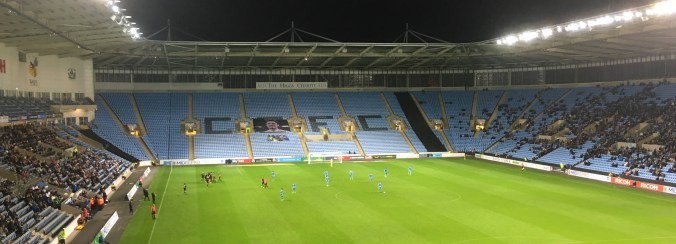
The first thing I noticed in walking around the outside of the two stadiums was how much space is taken up by the new stadia. At the Ricoh Arena, home to Wasps Rugby Football Club and Coventry City FC, (tenants listed by size of average attendance), I suspect that the footprint of this facility is close to three times the size of the playing surface. The development includes hotel and conference facilities, a vast array of catering options, an indoor sports hall with a 12,000 capacity (that is also used for gigs and shows), and a casino. Football is a sideline.

The casino is an interesting element. During Pompey’s visit on 2nd October, a fellow supporter said, “Everyone was in the casino.”  (which raises concerns about his ability to count and also makes him an ideal candidate for the Black Jack table). Personally I am totally against such places. Money takes enough sweat to earn, so why chuck it away when you could spend it on a Pompey home game?

Inside the Coventry complex, behind neon signs and towering cliffs of plastic cladding is a football pitch and seating for crowds in excess of 32,000. When talk turns to visualising an ideal ground, (a regular topic in the queues for loos at Fratton Park, or the cosy crush in the South Stand Upper concourse), capacity is often discussed, along with sight-lines and toilet queues and drains.

The space behind the stands at the Ricoh Arena is impressive. The choice of Pompey videos to entertain visitors at the bars was thoughtful, the toilet queue non-existent. Overall not an unpleasant setting to visit. I also thought that the angle of the stand, (it seemed quite steep), helped The Blue Army produce a great sound that evening. So what was the problem?

The problem was trying to spot the home fans, (“Ultras” as Palace fans like to say in their sophisticated South London way). Where were the home fans?

As it turned out the home fans were located to the right of Pompey section and so had no chance of making any dent in the Pompey Wall of Sound. The other end of the ground was taken up by a vast empty shrine to the late Jimmy Hill with no-one but ball boys in attendance. It was left to visitors from Portsmouth to bring our own atmosphere and help entertain the locals.

So here’s the problem; in a more rounded stadium, where do home fans gather? How is the atmosphere built, sustained and maintained? Fratton Park can be an intimidating prospect for visiting teams, but could we keep that if we were to ever move?

I was working down the road just the other day. It was a match day and walking around that plastic stadium I was again struck at how much space a new ground takes up. This one, opened in 2001 it has at least two major flaws (some might say 30,000 flaws, but we’ll discuss that another time).

The first issue is that it is laid out from goal to goal on an East – West line.  With the sun low in the sky the Northam End, where visiting fans are placed, can be bathed in blinding sunlight. Many Pompey fans will remember a ridiculous mid-winter sunny midday kickoff when it was impossible to see what was happening for much of our 0-3 defeat (thankfully). When building an open-air sports facility, make sure to check where the sun is during the winter football season, i.e. usually low in the sky and following a rough east-west trajectory.

IMG_9697

RCD Espanyol where a kickoff before sunset would disturb the afternoon siesta

The second problem is the lack of an end for the home fans and the subsequent loss of atmosphere. At the Chapel End there is the family section with all its weird cartoon characters, (in addition to children’s entertainment and clowns dressed up as mascots).  This family section is as far away as possible from visiting supporters so they are less likely to witness any off-putting scenes close up, such as Pompey fans celebrating spectacular last minute goals. (Click link for gratuitous You Tube clip of a random David Norris effort).
47992F4A-8BEB-4436-8AB4-0C6B6982FC88

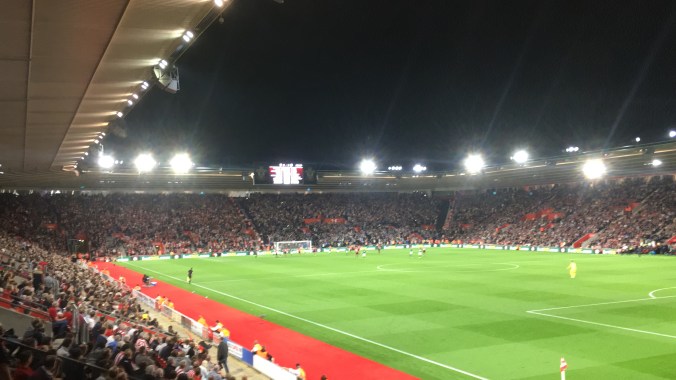
Distant view of Brighton fans on a Big Night Out

So if the family section takes up much of one end, do the Ultras spread out into the stands or, do they have to compete for an end with their guests? When I say compete, I mean try to out-sing, out-chant; the kind of thing that builds an atmosphere.

As Pompey fans most of us will have only ever been at this particular ground when 27,000 people are united in their bilious hatred of 3,000 of us, but on normal match days the atmosphere is very different. The crowd only unites and makes a bit of noise when things are going well – just like White Hart Lane. Besides the obvious, why is this? I think it’s because no one knows where the home end is; there is none. Without a concentrated end of fans doing all the blind-faith things they do we could be reduced to plastic clappers (as Sc*m have used), goal music (Urgh! Wolves?) or blokes with loudspeakers (any French Ligue 1 ground) to try and get the fans going.

This is a problem created by poor ground design. Too many new grounds have been  developed with money making in mind and not football as a priority. I believe that our friends from the USA see this is a major challenge in developing better facilities for Pompey fans. Pompey has to be a sustainable venture financially, operating competitively, but it will mean nothing if we become another Bolton Wanderers who play their games in an empty, soul-less concrete bowl out of reach of the local town, near the motorway, with reduced gates and little to shout about.

So if you have a bit of money to spend on a new home, yes, make sure that there is enough space, but absolutely definitely, without fail, make sure that there is a home end, none of this half-baked good site lines, nice catering, decent toilets, lovely hotel and a casino nonsense. Those are the extras, not what makes supporting Pompey so special.

CLP  08/10/2018
“How to be a Footballer” by Peter Crouch

E935B2C3-88AF-4494-9E54-0EAD3F46B9DE

Fratton Park just two stops on the carousel of Peter Crouch’s football career.

For those of you interested in books by former employees of Pompey, this one may be worth a look. It is currently half-price in Waterstones (at at 12th September, 2018), representing a saving of £10 for a hardback copy. However, this is not a book review, just my excuse to write about Peter Crouch, a player I had great respect for during his two contracts at Pompey at Championship and Premier League levels.

Crouch was originally bought by Pompey from QPR for £1.5m in 2001. It was at QPR that he had first signed as a school boy before going to Spurs as youth player and then being sold back to QPR for £50,000.  This was the first inkling that he was a player happy to move back and forth between clubs if it meant he would get a game. He later returned to Pompey after a while at Aston Villa (sold there by Pompey for £5m in 2002); via a loan trip to Norwich; a transfer to the west Hampshire club now owned 80% by Gao Jisheng;  then Liverpool who paid £7m to sign him and then back to Fratton Park for £11m in 2008. Crouchy was then transferred for £10m to Spurs. Clearly a popular worker to have been welcomed back by so many former employers.

Is there any other top league player who has been able to dance between clubs with such agility? That he also had a spell at Chelsea as a ball boy, despite supporting QPR, suggests he gives a good interview.

My first memory of seeing Crouch playing was from 4th February 2000 in the 1-1 draw away at QPR. The young centre forward proved to be a challenge for the Pompey defence that afternoon and the QPR fans protested shrilly at the rough treatment their No 9  received  at the hands, knees and elbows of player-manager Steve Claridge’s team. Despite Crouch’s spindly frame and light-weight, there was something about the timing of his jumps and his ability to hold and lay the ball off that was impressive. He did very well in the first half and was unlucky not to score, but nodded the ball down to Paul Peschisolido for the early QPR goal. The other thing that impressed me that afternoon was that he actually finished the game, showing great determination and grit despite the battering he was getting.

In the second half, before or just after Lee Bradbury’s equaliser (I can’t remember precisely), there was a tangle of limbs and Crouch fell to the ground in a pile with Darren Moore. Both players were a little off balance, QPR fans howled for a penalty and became even more incensed as the massive frame of the centre-back Moore clambered to his feet, made a slight stumble and had to kneel on Crouch’s ribcage to return to standing. Needless to say Crouch didn’t move very far for a while.

I am pretty certain that Crouch lost his effectiveness in this game at that point, but the 19 year old soldiered on. The BBC match report mentions that Crouch was lucky not to get a red card for a late tackle towards the end of the game, likely the frustration of being bullied by Darren Moore for 90 minutes finally getting to him. However, the youngster stuck it out.

I did not previously know that Peter Crouch played for Dulwich Hamlet and IFK Hassellholm on loan when first at Spurs – at least in Sweden at 6’7″ he would have felt as if he was a normal height. Apparently he went on loan with Alton Therwell to Sweden as part of a £70,000 transfer arrangement for Jon Jonsson who was wanted by Spurs. I had never heard of Alton Therwell, nor Jon Jonsson before I researched this article, so Crouch has a head start on these two when writing a book called, “How to be a Footballer.”

Other memorable moments from the career of Peter Crouch that I recall are his scoring a last minute winning penalty against us in an outrageously badly refereed FA Cup game in west Hampshire, (when Matt Taylor was so unfairly penalised for the ball hitting the point of his shoulder); two extra time goals for Pompey in Portugal in the UEFA Cup group match to send us into the group stages and some spectacular overhead volleyed goals that demonstrated his agility and gift for scoring.  42 England caps and 22 international goals to add to 100 Premier League goals underline his credentials as a talented player. Crouchy has done well for himself and his multitudes of team-mates.

Born in January 1981 and still playing at Championship level with Stoke City in September 2018, Peter Crouch has given a good crack at a playing career. I am sure his second book will provide some unique insights to the work of a modern footballer. Peter Crouch has played at enough clubs to be able to give some sound advice about how to progress in this line of employment. HIs autobiography, “Walking Tall – My Story” was published in 2007 when he was at Liverpool. I wonder if he realised then he would still be playing 11 years later?

How to be a Footballer is published by Penguin Books

CLP  12/09/2018

Season’s End

16A1E6D1-891D-46B0-A80A-439EEF5BCDE5.jpegAt last wind from the sea is welcome.

Dust not leaf litter blows along gutters

Pollarded beech trees add leafy tints

to Frensham Road.


The movement of people is looser

in summer shorts, blue shirt tops,

although blue and white of Pompey scarves

is still worn despite cricket weather heat.


Excitable sons gambol alongside

long-striding men looking ahead

to August,

ignoring twelve mid-year weeks,

while grandads show gentle interest,

kindly coaxing little lads back

onto root-lifted pavements,

answering high-pitched questions about who might play

and why another favourite won’t

and this and that and, and, and…Grandpa?


A block-shaped car

is parked particularly precisely,

a wheeled chair is removed,

unfolded, locked into shape

and careful, strong-gripped manoevres

position a determined animated,

colourfully dressed fan,

safe into place, ready to roll

to sit in concreted shade,

where eyes sharpened,

alight to athletic movement

on mown patterns, across white lines

pitched between flag-marked corners,

watch keenly every detail of pre-match

preparation and ritual.


Contrast from the shadowing South Stand,

marks near black on brilliant green,

cuts so sharp that momentary

sight loss flickers in eyes squinting

to adjust as they chase

colours, given stronger tone

by Sun set high with a perfect seat,

but who has to drag herself reluctantly away out west

before the final whistle,

but only after pouring one last gulped pint

of welcome warmth

into sun-glassed faces.


Impenetrable bright sky, sets off the scene in blue hue not seen inland,

so blue that stars behind become anxious

they will not get on to play tonight.


Wide-winged gulls’ cries of the sea are drowned at birth,

over-whelmed, engulfed in waves of voices,

by microphoned, amplified announcements,

strong rhythms, clapping, chants and songs.


For some this is the last match.

No substitute will step in when they get pulled from the pitch.

Some will know their part near played up,

others will depart the game in shock,

their removal a surprise to all.


Unfair, unwarned and fiercely questioned,

why did they get The Manager’s call?

Yet another sign of unfathomable tactics.


Next season, last game in fresh May

their names will be on the lips

of the man who reads The List

of those who once so happily

trooped along to Fratton Park.


CLP 05/05/2018

Dedicated to Albert Perry “Grampy”