The Referee’s Law Of Common Sense

I was out for a walk a couple of weeks ago and met a man named Mervyn Cawston, who the coffee van woman said is a legend.  He was a little embarrassed by her comment, but it turns out he had played competitively against Pele.  That was when Mervyn played for Chicago Fire against New York Cosmos when Association Football was still new to the USA.

I announced myself as a Pompey fan and Mervyn perked up to tell me that he had played at Fratton Park once.  He had been sent out on loan by Norwich City to Southend United for the latter part of the 1982/83 season and played against Pompey when we had promotion from Division 3 confirmed.   I was at that game with my Golden Wonder sales colleague, John Hine, and I recalled we won 2-0.  “I think that the first goal was my fault.”  Mervyn said, before checking online for a video of highlights.  When I got home I found a ten-minute video posted from the ITV archives.

Mervyn was right, he had dropped a corner early on and the loose ball was lashed home by Kevin ‘Dead-eye’ Dillon from about ten yards.  Fratton Park nerves were initially settled by Dillon’s effort, but it took a flying header from Alan Biley at the Fratton End, late into the game to unleash the celebrations.  As the game moved toward its conclusion, the Fratton faithful edged out from terraces and lined the whole pitch.  There was no room for the ball to fully cross the line for throw-ins, but nobody encroached onto the field while the game proceeded.  The commentator, Gerald Sinstadt, became concerned that the referee was insisting on ensuing that the full ninety minutes, plus injury-time was played.  Sinstadtwondered at one point why Mr Eric Reed from Bristol, was not applying the unwritten law of common-sense to the situation.  The crowd was getting quite raucous as the clock ticked on.

Eventually, with the ball as far away from the tunnel as possible, in the corner of the Milton End and North Stand, the final whistle went and Pompey fans invaded the turf to engage in good-natured celebration.  Sinstadt’s criticism of Mr Reed was mild by modern standards, but I am sure the referee was trying to be fair to Pompey and all the other teams in Division 3 by insisting that the game was finished at the right time.  An early finish might have led to complaints about bias, or even cowardice, thus staining his refereeing reputation.  There may even have been an official enquiry, possibly a re-match that could have led to Pompey not getting promoted.  Difficult though the situation was, Mr Reed saw it through to the bitter end, ensuring fair play for all. Which is all we really want from our referees.

You can find the video by looking up ‘pompeyfanmike’ on YouTube, who has put some great material online.  Watch the Southend United highlights to the end and you will see an interview with the irrepressible Alan Biley, (who had reachedhis career highest goals in a season total with that afternoon’s header) and the club Chairman, Mr John Deacon.  It is an interview that the taxman may well have looked at twice, because when the attendance for the afternoon was asked, John Deacon said immediately and with a straight face, “Eighteen Thousand.” This crowd figure came as a surprise to me.  I had been at Fratton Park for a Division 3 match against Brighton a few years before when the crowd was 36,000 and that crowd was not much larger than for one celebrating Pompey’s promotion in 1983. Cash on the gate led to a few puzzling attendance figures being announced back then.

Mervyn was delighted to have met someonee who had been at a game he played in and I look forward to catching up with again before too long.  He’s got some great stories to share, not least about the former Pompey centre-forward, Ron Saunders, who was once Mervyn’s manager at Norwich City.

 ~

Jobsworth

A slip, a fall, a trip, a push
I’m the one who has to decide
Do I blow the whistle?
Should I let it ride?

A goal, off-side or on?
Keeping up with the back-line’s moves
Takes concentration
With the North Stand baying

I need a sense of humour
With these grown men playing
Though I know it’s their job
With mortgages to be paid

I have mine too, I‘m just saying
Me and my assistants do our best
To keep the game flowing
Come on lads, it’s only a thrown in

Ninety minutes plus added on time
Jobs depend on getting things right
But if that was a slip or that was a foul
Who’s made the error?
Was it the referee
Or the football player?

~
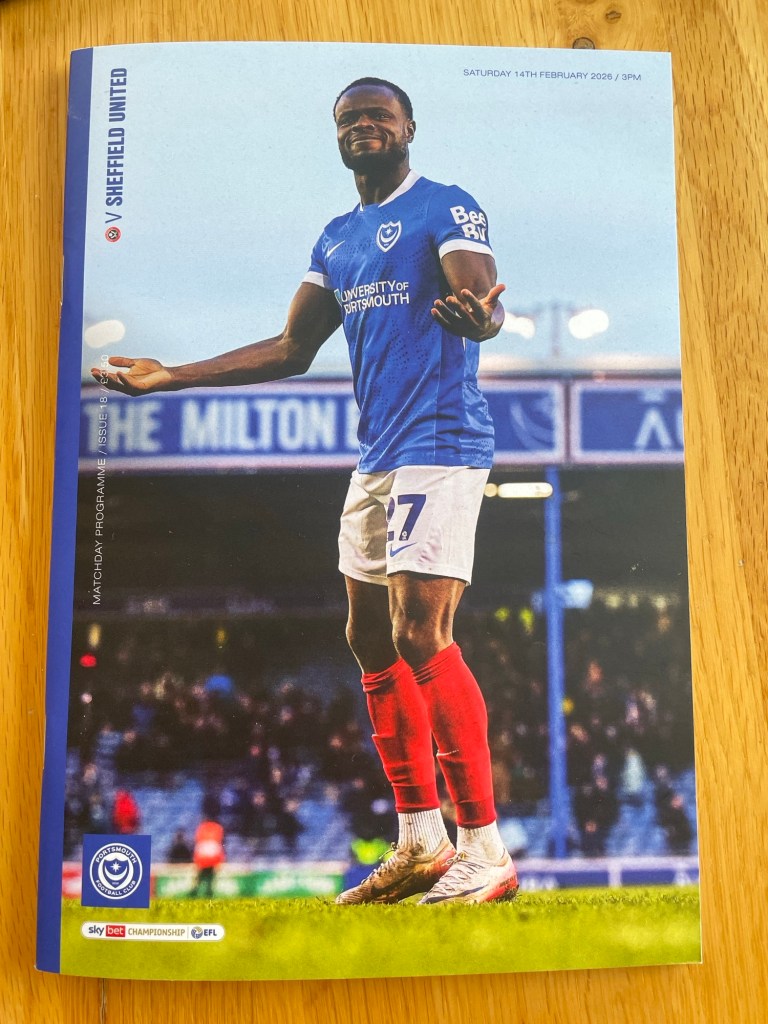
n.b This article first appeared in the Portsmouth FC v Sheffield Wednesday FC match day programme on 14th February, 2026

Chris Perry

5th June, 2026

Flagging Interest in the FIFA World Cup 2026

The 2026 FIFA World Cup, is scheduled to be hosted by the Canada, Mexico and the USA.  A second cross-border tournament, first successfully undertaken with the South Korea-Japan tournament of 2002, will present some wonderful memories for those Pompey fans who will travel to support England. Group match tickets, starting at $60, are being allocated through a world-wide lottery.  Final tickets start at $2,030 a piece.  Getting into games may well be an exercise in who you know, or meet on your travels. 

Many of us watching England on the box will also take part in the age-old parlour game of spotting the various St George’s flags from around the country.  It is always cheering to see a Pompey flag in the array of England flags ringing a foreign field.  Spotting Pompey flags at non-England matches during a major tournament gains extra points, by the way. 

Noting names of other clubs and towns on English flags is another side-show, particularly when full backs and centre backs are trading side-passes in the stifling heat of a New World summer. For example, one that caught my eye was Workington, stitched into a flag prominently displayed for the group qualifying match in Tirana, in mid-November.  

Workington AFC, located thirty-five miles south-west of Carlisle, on the Whitehaven coast, would have been a challenging away trip for any lower division team, after the club was elected to the Football League Division Three – North, replacing New Brighton in 1951.  Workington lasted in the Football League until 1976/77, when after winning just four matches that season, it was replaced by Wimbledon FC.  The club made little impression on the Football League, (apart from being a step on the way to Anfield for Bill Shankly and the launch pad for goalkeeper John Burridge’s 798 professional game career), but Workington’s supporters are still proud to support the English national side.

In a club versus country debate, my loyalties have always put Pompey first, then I’ll follow any international side that features Pompey players, past or present.  This permits me some leeway when watching a major tournament, but this year, it will be 60 years since HM Queen Elizabeth II presented Bobby Moore with the Jules Rimet Trophy at Wembley.  That steamy July day in 1966, is one of which I hold some clear memories.  My dad had bought a new black & white television, on which he watched the match with a work friend, while I was left to follow events on the older TV set in the back room.

I distinctly recall Hurst’s header, Peters sweeping the ball home for England’s second and then Geoff Hurst’s thumping third that settled the match beyond all doubt, ensuring that there would be no replay had West Germany equalised again.

Of the controversy about the ball which did not cross the line, or the scrambled 90th minute West German equaliser, I cannot recall.  I do remember by first brother wandering away bored from the TV, and going up to his room during the match to play with the Lego.  At the time I questioned his commitment to the beautiful game.   If he couldn’t sit through a World Cup Final, how would he ever be a proper football fan, I wondered. He had celebrated his fifth birthday a couple of weeks previously, old enough for school, so old enough to know about football, I reckoned, already being a world-weary six-and-a-half-year-old myself.

Geoff Hurst is still my hero for his three goals in 1966, but it was twenty-one-year-old Alan Ball, who ran the show that day. If you watch a recording of the match, you will see the player, who was to become a famous Pompey manager, run non-stop for the team that World Cup Final day.  He was a vital cog in Alf Ramsey’s ‘Wingless Wonders’ winning formation.  No Pompey fan watching in ’66 could have dreamt that the little guy wearing the No 7 for England would be the man to steer Pompey up to the top Division for the first time in twenty-eight years.

Here’s a game of imagination for you to try, while watching the FIFA tournament whittle forty-eight teams down to the final two, consider who of all the players you see, see if you can spot one who one day may become a member of the Pompey family.

~

The Seven Stages of An International Career
All the world cup’s a pitch And all the men and women merely players

They have their appearances and their substitutions

And one man in his career plays many parts

His games being in several parts.  At first the debutant

In awe of his team-mates, who know the score

And then the unused substitute skipping and stretching

Shining with enthusiasm, trying to catch the coach’s eye To get on the pitch,

And then the player, Growling like a lion, during the national anthem

Sung with patriotic passion.  Then a hardened pro

Full of feints and moves, making the killer pass

United in loyalty, sudden and quick in a challenge

Seeking the winner’s reputation

Even in time added on for stoppages. And then the coach

In fair round belly with peaked cap on With eyes severe and beard of formal cut

Full of wise tactics and modern formations

And so he plays his part. The sixth age shifts

Into the sad and slipper’d panel pundit

With spectacles on nose and on the couch, side on;

His too young clothes, well sav’d, the screen too wide

For his shrunk name and his big manly voice

Turning again toward petty gripes

Complaints of VAR and referees’

Unfair whistles.  Last game of all

That ends this strange, eventful career

Is with child-like enthusiasm and mere oblivion

Sans shirt, sans club, avec memories et medals.

 ~

(with apologies to W Shakespeare)

~

n.b. This article was first published in a Portsmouth match day programme, details tba.

Chris Perry

02/05/2026

Some Foreign Field

Roads and streets unfamiliar
Filled with grey drawn faces
That peer down at tipsy slabs underfoot
Coats pulled tight to tucked in chins
Fists pushed deep into pockets
Stooped figures limping toward the electric-white glow
Pale shadows struggle to keep up
With these sad shufflers
Wrapt in hopeful talk.
The same battered cars line kerbs
Bumpers kissing
Litter blown by stiff north-easterly draughts
Sticks carelessly to railings
Ice in rain fills holes in the cold breeze
Pricks pins in my face
Grey sky adopts a gloomy shade
Their stadium leans in on itself
Perpetually introvert
Morose
Its pointless activity
Steals any joy
From coming dawns
Scarves and shirts in reds and whites
Accents more rural than this dockland setting
Suggest spaces more green
Less concrete
Than this
This is far from our home
Where blue skies shine
Brilliant sun parades
Strong enough to make eyes squint
When we wake
It warms our blood
Calls us to play
Unfettered by fear of failure
At night the star and crescent
Heaven's light
Our guide.
This is their place
I leave them
Happy
To be miserable

CLP 27/10/2018